

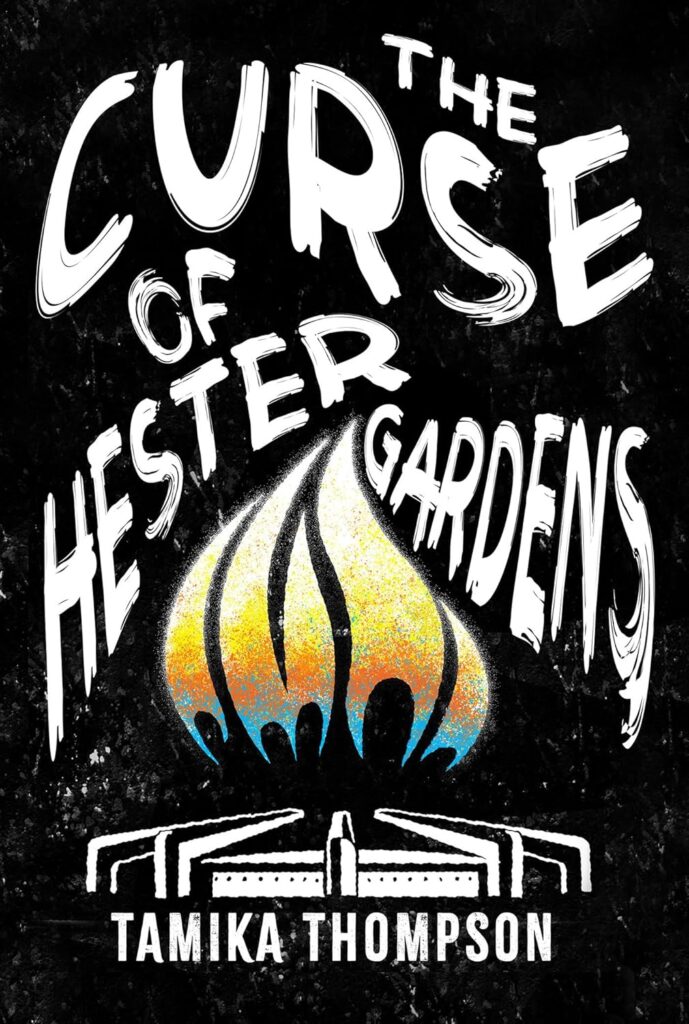
Tamika Thompson is author of The Curse at Hester Gardens. A former journalist and producer, she is also author of Unshod, Cackling, and Naked, which is the 2024 Next Generation Indie Book Awards Winner for Horror, as well as author of Salamander Justice. Her work has appeared in several speculative fiction anthologies as well as in Interzone, Prairie Schooner, The New York Times, and Los Angeles Review of Books, among others. She lives in the San Francisco Bay Area, where she hosts her own blog and newsletter, Tamika Talks Terror. Find her on social media @tamikadthompson.
I had the opportunity to interview Tamika, which you can read below.
CW: Discussion of Gun Violence
First of all, welcome to Geeks OUT! Could you tell us a little about yourself?
Thank you so much for having me! I’m an author of social horror and suspense, and I’m proud of the horror genre, of what it’s accomplished thus far and where it’s headed.
I was born and raised in Detroit, Michigan, but I’ve been on the move since, having lived in New York, Los Angeles, Chicago, and now in the San Francisco Bay Area. There was even a summer in grad school when I lived and worked in Cape Town, South Africa.
I first left home at eighteen to study political science at Columbia University in New York. I worked for two years in television production and went to graduate school at the University of Southern California to get a master’s degree in journalism. Afterwards, I worked as a broadcast and web producer for a number of years before becoming a writer.
As a writer, I’ve co-edited an award-winning multi-genre anthology for writers of color called, Graffiti, I wrote a horror novella, Salamander Justice, an award-winning speculative fiction collection, Unshod, Cackling, and Naked, and my debut novel, The Curse of Hester Gardens, is out this spring.
What can you tell us about your project, The Curse at Hester Gardens? What was the inspiration for it?
The Curse of Hester Gardens is a gothic novel set in a public housing project that follows one mother, Nona McKinley, as she faces the twin specters of gun violence and a supernatural curse.
She’s been raising three boys in the Hester Gardens section of the fictional town of Medford, Michigan, and when the story opens, her drug dealer husband is already behind bars, and her eldest son Kendall has been shot to death at eighteen.
Her second son, Marcus, is on the right path. He’s a valedictorian heading to an Ivy League school, and he can get out of their high-crime neighborhood. But strange things start happening to Nona and to other residents in and around Hester Gardens—phantom sightings, footsteps when no one is there, and appliances turning on by themselves. Nona’s youngest son, Lance, is hanging around with the local gang, the Hester Boys, and Marcus, the one she’s hung all her hopes on, becomes moody and secretive. Sometimes he even seems to act like a completely different person. As time goes on, she fears that someone—or something— is seeking revenge for an act she made in a moment of weakness to protect her family.
I grew up in a high-crime neighborhood in Detroit at the height of the crack epidemic, about a mile away from a real-life housing project called Herman Gardens, which is one of many housing projects that served as inspiration for Hester Gardens. My research as a journalist included gun violence in America as well as gang violence, and those years of reporting and reflecting, along with the real-life experiences from growing up in Detroit, are the foundation and inspiration for the book. The novel is dedicated to my late uncle, who was shot death when I was young and to all people who have lost their lives to gun violence in America, which these days amounts to about 50,000 people killed each year.
As a writer, what drew you to the art of storytelling, especially speculative fiction/horror?
We had a strong oral storytelling tradition in my family, and when I was young, my bedtime stories were horror stories, folklore, and ghost tales. One of my favorites that my mother and grandmother told me was the story of Bloody Bones, an urban legend that served as inspiration for one of my short stories, “Angry Slash of Blood.” Each time my mother or grandmother told it, they’d add different details and new frights so no two versions were the same. I also read a ton of books, watched a lot of television, and I worked as a commercial and stage actress, so my early life was steeped in story and character.
I also consumed a steady diet of horror when I was young. Everything from slasher films, The Twilight Zone, Tales from the Dark and Tales From the Hood to the Scary Stories to Tell in the Dark book series. Horror stories mixed with my background in journalism and news production meant that when I finally sat to write, my pages all ended up being very dark and grotesque. The transition from crafting news stories to horror stories was seamless because so much of our news is horrific.
How would you describe your creative process?
I gave myself permission from the beginning to set up a writing practice with dedicated time and space to craft stories, and I spend time each day working on my pages.
I also remain observant as I go about my day, jotting down notes on an app on my phone or in a journal I carry in my bag. I draw inspiration from the mundane or the slightly off-kilter that I notice. For instance, a bat once landed on my mother’s screen door during daylight hours and remained there for most of the day in direct sunlight, an odd occurrence because bats are nocturnal. I turned that into a horror story called, you guessed it, “The Bats.”
I spend time drafting a story or novel, I put it away for a while to work on other projects, and then I return to revise. I revise multiple times before I show it to anyone. And I revise after every early reading of the book. I only show it to my agent once it’s gone through that process, and then I revise again after agent notes. I believe the revision process is how the author earns readers.
What are some of your favorite elements of writing? What do you consider some of the most frustrating and/or difficult?
My favorite thing about writing is discovering the characters’ choices as I’m drafting and revising. They often surprise me, and some characters that I think will be in the background will often leap off the page and become a stronger voice in the story.
The hardest part of writing is guarding the writing time. There are so many people and life pressures that can get in the way, and I have to protect my writing, reading, and revising time on behalf of the stories that have chosen me to get on the page and into the world.
As an author, who or what would you say are some of your greatest creative influences and/or sources of inspiration in general?
My north stars are Octavia Butler, Tananarive Due, Linda Addison, Toni Morrison, Walter Mosley, and more recently Percival Everett. I also take a lot of inspiration from music, particularly jazz, hip hop, R&B, soul, and gospel music. The Curse of Hester Gardens includes a playlist because music is intertwined with the scenes.
Aside from your work, what are some things you would want readers to know about you?
I’m a plant-based eater and have been on a vegetarian/vegan journey for nearly two decades. It grew from my spiritual practice and has proven to have health benefits as well. This shows up in a lot of my creature feature, eco-horror, and dystopian work, particularly narratives that straddle horror and science fiction.
I’m also disabled. A few years ago, I experienced unexplained hearing loss with tinnitus and wear a hearing aid because of it. Accessibility is important to me, particularly since we can’t always see a person’s disability. In my case, I have a thick head of hair and folks don’t know I have a hearing aid unless I tell them. So, we should just make everything accessible all the time, whether we are aware of people’s disabilities or not.
And for the love of God, use a microphone at public gatherings, people! Wherever I’m sitting at your event, I probably can’t hear you without a mic.
What’s a question you haven’t been asked yet but that you wish you were asked (as well as the answer to that question)?
Question: Tamika, name your favorite horror villain and final girl.
Answer: My favorite horror villain is Red from Jordan Peele’s Us. My favorite final girl is…Red from Jordan Peele’s Us.
What advice might you have to give for aspiring storytellers out there?
I always tell aspiring and early-career writers to persevere on behalf of their stories. There are a lot of amazing and talented writers who give up on their projects or jump from project to project without ever finishing one, and, at some point, you have to buckle down and push through. This perseverance will come in handy when you begin the agent query process, go on sub with editors, and when you are in development, production, launch, and the marketing phase for your work. Every step of the process requires perseverance.
Are there any other projects you are working on and at liberty to speak about?
I’m working on my second novel! It is a departure from the world and characters of The Curse of Hester Gardens. The subject matter isn’t as devastating, yet the horror is more grotesque.
I also have a new horror novella and new story collection in the works. I love all of my characters, the good and not-so-good ones, and I can’t wait to share them all with the world.
Finally, what books/authors would you recommend to the readers of GeeksOUT?
How much time do you have?
Okay. I’ll keep it brief. I promise!
Grievers by adrienne marie brown.
We Came to Welcome You and You Should Have Been Nicer to My Mom by Vincent Tirado.
Really, whatever you can get your hands on by Vincent Tirado is going to be amazing.
Flowers for the Sea by Zin E. Rocklyn.
The Rat King by Sumiko Saulson.
The World Wasn’t Ready for You by Justin C. Key.
The Dark Between The Twilight by Jamal Hodge.
House of Margins by Tlotlo Tsamaase.
Things Are As They Should Be by P.M. Raymond.
Lesser Known Monsters of the 21st Century by Kim Fu.
Flowers From the Void by Gianni Washington.
Within the Shadows by Brandon Massey.
Everything ever written by RJ Joseph, Candace Nola, L. Marie Wood, Kenya Moss-Dyme, Paula D. Ashe, and Mo Moshaty.
I could really keep going here, but I’ll stop.
Header Photo Credit Renee Sweeney
0 Comments