
Tesia Tsai was born in Los Angeles to immigrant parents from Taiwan. She currently teaches at Brigham Young University, and lives with her husband, two cats, and a dog in Utah. When not writing or reading, she enjoys watching Asian dramas, playing video games, and planning her next trip.
I had the opportunity to interview Tesia, which you can read below.
First of all, welcome to Geeks OUT! Could you tell us a little about yourself?
Thank you for this interview! I was born in Los Angeles to first-generation immigrants from Taiwan, so I speak decent Mandarin (it’s deteriorated over the years, unfortunately). Our family moved to Utah when I was eleven, and I’ve been here ever since! I studied English and editing in university, and later completed an MFA in creative writing. Besides novel writing, I enjoy dabbling in personal essays and journaling. I also like to spend my free time watching sitcoms and Chinese dramas, playing video games, and traveling when I can. (Some of my favorite places have been Taiwan, Thailand, and England!)
What can you tell us about your book, Deathly Fates? What was the inspiration for it?
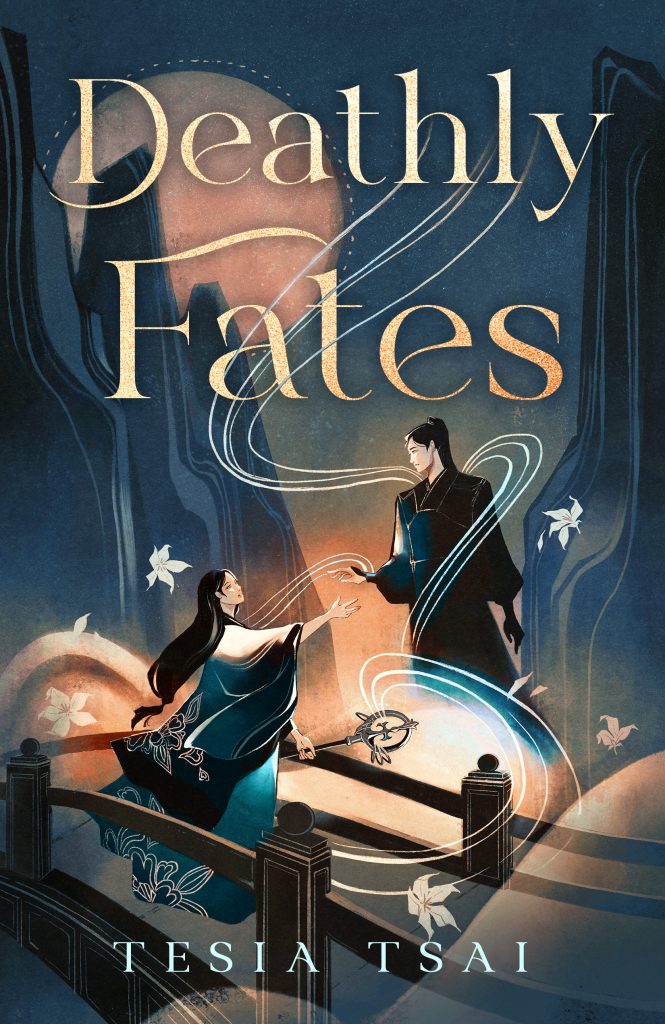
Deathly Fates is a YA fantasy set in an alternative ancient Chinese world. It’s about a priestess who accidentally brings a dead prince back to life and strikes a deal to help him gather enough life force (qi) to stay alive. Sprinkled throughout the story are evil spirits, folkloric elements, and political intrigue. Also, a dash of romance!
I was inspired initially by Hong Kong jiangshi (hopping vampires) movies that my mom used to watch. While researching the background of those supernatural creatures, I came across the ancient practice of corpse-driving, where Taoist priests were hired by less affluent families to retrieve the bodies of loved ones who’d passed away in distant towns/cities. The lore was really fascinating and appeared less gruesome than expected, rooted in a culture that values family and peace for the dead. So, from there, I started coming up with a story inspired by that folk practice!
As a writer, what drew you to the art of storytelling, especially speculative fiction and romance?
Growing up, my mom would often tell my siblings and me stories before bed. Sometimes she made them up on the fly; other times, she referred to the reservoir of Chinese folk- and fairytales she’d internalized from her youth in Taiwan. I loved her stories, and I loved imagining the characters, settings, and plot points she described. Then, in elementary school, I developed a love for books, especially fiction. I particularly enjoyed the ones with fantastical beings, like vampires, mermaids, or witches. My obsession with romance came later, in my preteen/teenage years. (Ella Enchanted opened the door; Goose Girl by Shannon Hale flung it wide open.)
How would you describe your creative process?
I like to start with a purpose—what kind of story do I want to tell? What character, situation, or question best fits this story? What is something I care deeply about and would like to explore through fiction? Once I settle on a central theme or intriguing element, I begin brainstorming the plot points, the main character’s arc, and the ending. Often, I’ll mull over ideas for months, refining them in my mind. When I feel ready, I like to use the Save the Cat! beat sheet to help me with an initial outline, and then I start drafting!
What are some of your favorite elements of writing? What do you consider some of the most frustrating and/or difficult?
My favorite moments of writing come when the pieces just seem to naturally fit together. This can happen in the drafting stage, where I’m still partly discovering things as I go. But it happens more often in the revising stage, when I’m cutting, adding, or smoothing out what’s already there. I also feel a lot of satisfaction from the days when a great idea for a scene pops into my head, and I really, really want to write it—not because I’m on deadline, but because I’m having fun.
The most difficult part of writing, for me, is filling up blank space. I complain about revisions when I’m in the thick of it, but it’s much less stressful than writing a whole book from scratch—that is, creating a first draft. Some authors love the explorative aspect of writing something new. I feel like I’m pulling teeth, trying to translate my ideas to the white page. To keep myself sane during this stage, I keep to a consistent writing schedule or plan. Five hundred words a day. Or an hour of writing a day. Either way, and no matter how small or messy, write something regularly.
As an author, who or what would you say are some of your greatest creative influences and/or sources of inspiration in general?
I always think first of Marie Lu. Her debut, Legend, was the first YA SFF I’d ever read that was written by an Asian woman. I loved how she was inspired by Les Mis and asked herself how she could twist and retell the tale. Reading that book as a teenager, I felt more confident that someone like me could become an author one day. (I actually emailed her when she was still a new author, and she responded with a kind message that included advice on finding an agent. For that reason alone, I’ll always view her as a shining example of my dreams.)
Laurie Halse Anderson is another name that comes to mind. I devoured her books when I was younger, and I was deeply moved (and inspired) by her poetic writing. It’s because of her that I have a soft spot for emotional storytelling and short, punchy sentences.
Lastly, I have to give a shoutout to Martine Leavitt, who taught a YA workshop when I was in graduate school. She was a compassionate mentor who knew how to push her students in all the right ways. While working with her, I was able to find my purpose in writing and figure out how to share my light through my stories.
Aside from your work, what are some things you would want readers to know about you?
That’s a great question. Despite being most visible on a tiny screen, I want them to know that I’m human and, like them, I’m trying the best I can—whether that’s in life or writing. I’ll make mistakes. I’ll fall short of the expectations that they (and I) have for me. But I truly think seriously about what I do, what I create, and what I share with the world. My biggest goal is to connect with at least one reader through my books, to help them feel seen or safe for at least a few hours. So, I hope my readers will be willing to give me grace, and continue following along with me as I try, fail, and succeed.
What’s a question you haven’t been asked yet but that you wish you were asked (as well as the answer to that question)?
I’ve never been asked how I deal with imposter syndrome, which I think most people (including myself) experience. From the outside, I’m sure I look successful and thriving to the people around me. I’m educated, I enjoy teaching part-time, and I’m several steps closer to achieving my publishing dreams. But the truth is I constantly feel less than and not good enough. Even when I’m succeeding, I can’t help wondering if it’s just a trick of the light, a random act of luck.
When imposter syndrome creeps in, I immediately shut my brain off to the people I think are doing “better” than me. I force myself to stop comparing. And then I mentally review all the things I have accomplished, all the things my teenage self would be amazed by. That usually helps my brain chill out a bit. But because we are our worst judges, I also reach out to the people who love and know me best. There’s no better confidence builder like a best friend metaphorically slapping you in the face with a “What are you talking about? You’re amazing. Now stop being stupid and go write.”
What advice might you have to give for aspiring storytellers out there?
My go-to advice is always something I heard a while back: those who succeed aren’t those who are the best at writing; those who succeed are the ones who refuse to quit. I’m a testament to that saying. Even when I felt inadequate, I remembered how much I loved to write, and I kept doing it until I eventually found the right people who loved my work too. If you feel called to writing, bet on yourself. Keep honing your craft. Take every story and book as a lesson, as practice. At some point, your belief in yourself will pay off.
Are there any other projects you are working on and at liberty to speak about?
I’m currently working on the second YA fantasy for my contract with Wednesday Books. I’ve been pitching it as “Beauty and the Beast” meets “The Legend of the White Snake” (a famous Chinese folktale). That’s all I’ll say about it for now! 😊
Finally, what books/authors would you recommend to the readers of GeeksOUT?
Ooh, so many!! Isabel Ibañez’s Secrets of the Nile duology is fantastic—beautiful writing, heart-stopping pacing, and a well-earned romance. I also recommend anything by Sue Lynn Tan (for the C-drama girlies) and June Hur (for sharp mysteries set in historical Korea). And, of course, I can’t forget to give a plug to my fellow 2026 debuts, who are all coming out with some amazing books! Some authors to keep an eye on: Alaa Al-Barkawi, Julia Alexandra, Delali Adjoa, Ashley N. Y. Sheesley, and so much more!
Header Photo Credit Stephen Bentley
0 Comments