

Dr. Catherine V. Yeh is Professor of Chinese Literature and Transcultural Studies at Boston University. Her research interest is in global cultural interaction and flow in the fields of literature, media, visual and entertainment culture during the 19th and 20th centuries. She has published widely on the subject, and her books include Shanghai Love: Courtesans, Intellectuals and Entertainment Culture, 1850-1910 (University of Washington Press, 2006), The Chinese Political Novel: Migration of a
World Genre (Harvard University Press, 2015) and Asia at the World’s Fairs: An Online Exhibition of Cultural Exchange (Project editor and co-author, Boston University 2018). Her current book project is Improbable Stars: Female Impersonators, Peking Opera and the Birth of Modern Star Culture in 1910s China.
Her current projects including The Dancing Goddess: Mei Lanfang in America, a current exhibition at the China Institute Gallery in New York City.
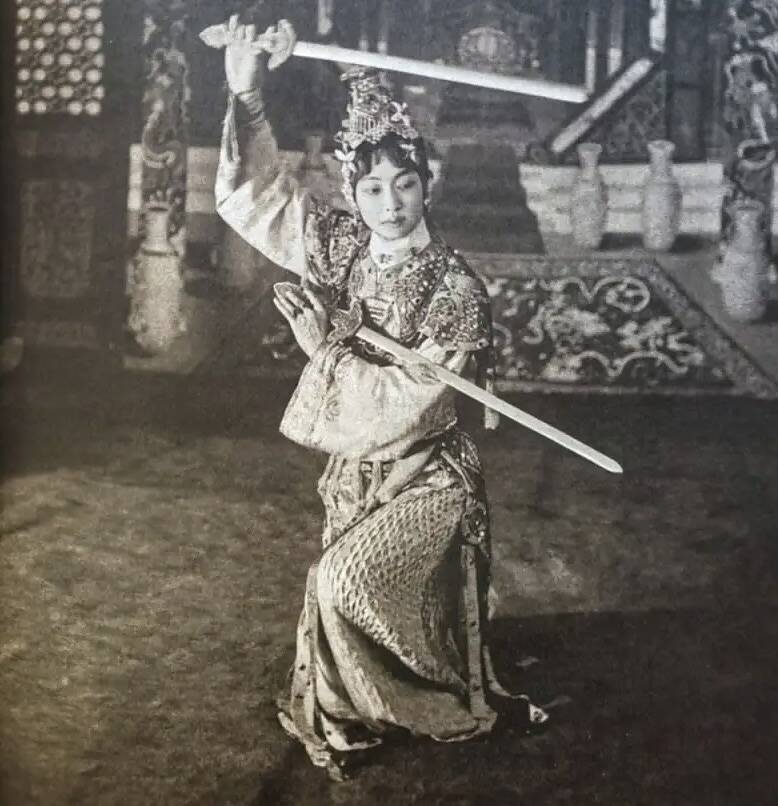
The Dancing Goddess: Mei Lanfang in America traces the performer’s U.S. tour through immersive multimedia displays, spectacular costumes, props used in the performances and rarely seen archival materials. Exhibition highlights include the earliest surviving playbill from Mei’s first performances at the age of 14 (his grandfather was a famous opera star) as well as playbills and photographs from the U.S. tour; costumes from the 1920s and 1930s with elaborate embroidery and sequins; images of Mei’s New York performance by Broadway photographer Florence Vandamm; and rare footage of Mei performing scenes from his signature roles, including Farewell My Concubine.
I had the opportunity to interview Dr. Yeh, which you can read below.
NOTE: This interview was conducted over zoom, and has been edited for clarity.
Could you tell us a little bit about yourself and your research?
Oh well, I grew up in Beijing and when I was a little girl, our housekeeper loved Peking opera, so the radio was always on when she was cleaning. So I actually grew up listening to Peking opera and of course, even there, in the late 50s, Peking opera was still the most dominant art form on stage. And so when I started to do research on Peking opera, I was interested in one question that sort of led me to one step after another.
It is very well known that during the Republican period, especially 1910s and early 1920s, there were four great dan (male performer) actors, not just Mei Lanfang, and each of them were national stars. And my question was, why the 1910s? This was just when the Republic was being founded. You would think Peking opera, which began in the late 18th centurywith the celebration of the Qianlong Emperor’s birthday, would be led by the old man’s role, right? For 200 years, this was how Peking opera developed. So why in the 1910s? These teenage boys, basically, take the Peking opera stage by storm. Mei Lanfang was only 17, 18around that time.
And why is this role that was so underdeveloped during the 200 years of opera history, now having this tremendous support from the ground up?
I just thought it was almost improbable that these youngsters were taking over the Peking opera stage.
That’s what started it. So, this is a very personal sort of history in my love for Peking opera. And that’s the journey that led me to investigate the rise of the dan basically.
What inspired the Dancing Goddess?
The Dancing Goddess, of course, is a pivotal moment in Mei Lanfang’s Peking opera reform. Peking opera was under tremendous pressure, like a lot of traditional art forms, such as calligraphy, Chinese traditional painting, Chinese philosophy, so on.
How is it going to be relevant to the 20th century? How is it going to be relevant in the demands of transitioning from a so-called feudal society to a democratic society to different sets of values?
Then the May 4th Movement exploded. And these intellectuals regarded Peking opera as the symbol of Chinese backwardness, the traditional culture imprinted with Confucius values.
So, they advocated to ban Peking opera altogether. I’m saying because in Peking operas, the aesthetic structure reflected values of the old society. They’re not wrong.
If you look at the performing, the women are very demure, right? The men are very upfront, right? So even from the movement, you can see, you know, that social power structure. So, Mei Lanfang’s reform is against this background of pressure.
How are you going to overcome some of this ideology? And the second thing is how do you connect with world stage? The 1910s were a very lively time.
If you go to Paris with the Ballet Russe, Isadora Duncan, Louis Fuller, etc., part of this coming of the goddess spirit flowers is that the origin, the stimulation, did not come from Chinese radical thinkers. Rather, it came from a reform-minded Chinese thinker that was in Paris. And his name is Xiu Shan, and he came back to China and said, we must have dance.
Dance represents the spirit of the 20th century. And so, Mei Lanfang and he said, “But we don’t have dance. Nobody knows how to dance.”
We lost it. So that stimulated them saying, “We can reconstruct classical Chinese dance.” So that became a big project.
I mean, they were so energized.
They redesigned the hairdo. They redesigned the clothing. And they created the dance steps. It became a cultural Renaissance in a way. Bringing in, ushering in the 20th century spirit of movement.
So that’s the moment of real change. And it was an aesthetic of motion. This is the new sort of aesthetics being injected into and reformulating Peking opera.
What can you say about the transcultural impact of Meilan Fang in the world of performing arts?
Mei Lanfang showed the limitation of realism because at that time, realism was the key. It was the height of theatric aesthetics. Mei Lanfang brought the understanding of symbolic acting or abstract acting. And that was actually talked about quite extensively.
And I think that’s a huge contribution to the discussion for the modernist stage and modern artists. For example, Thornton Wilder’s “Our Town” was stimulated by Mei Lanfang. So, you do a minimum stage and all the acting techniques, very much influenced by Mei Lanfang. And the second thing was when he went to the Soviet Union, USSR in 1935. All the major European theatre people went there, including Brecht from Germany.
And after seeing Mei Lanfang, he created his theatre alienation theory. And he specifically addressed that. After seeing Mei Lanfang, he got this inspiration.
And then the mother and father of American modern dance, Ruth St. Dennis and Ted Shawn, went to Beijing and then used the Peking opera, like “Farewell My Concubine,” and made it into modern dance and performed in New York and in Shanghai.
What is important is that people didn’t copy Mei Lanfang or Mei Lanfang did not copy Louis Fuller. They saw an opportunity for their own culture to blossom in a particular way.
And I think this is the dynamics of the transcultural… The culture lives on, learning from other cultures, but also reconsolidating self-identity, not giving that up.
So, this type of dynamism I find most exciting. And I think Mei Lanfang really demonstrated this energy of cultural regeneration.
What’s something you would want people who are not familiar about Chinese opera to know, whether from this exhibit or your work?
I want them to know that traditional culture is capable of transformation and that you do not have to lose yourself as time goes on, but you must change, you must reform, you must absorb the spirit of the time in order to still speak to people, to speak to the younger generation.
What looks totally traditional, if you look at the history, you realize they went through the same transformation. And much has changed. And I think that it is very important to view traditional culture as not a dead thing, but as a contemporary expression of cultural heritage.
It has to adapt, right? You adapt or else you’re done. So, I think culture is that. And culture is never isolated. There’s no national border.





0 Comments