
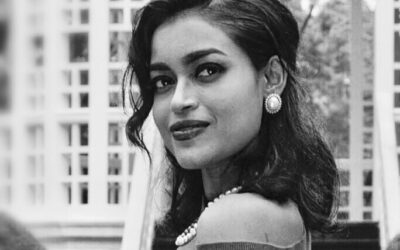
ZARA MARIELLE hails from two worlds: a Northern California hippy town and a rustic village high in the French Alps. A former ESL teacher, she loves to travel and has also lived in six different countries. Zara earned a master’s in creative writing from the University of Edinburgh in 2015. When she isn’t writing contemporary fantasy, she spends her time inventing much sillier, spontaneous content as an improv teacher and performer.
I had the opportunity to interview Zara, which you can read below.
First of all, welcome to Geeks OUT! Could you tell us a little about yourself?
Hello, Geeks! I’m Zara Marielle! I’m a fantasy author who grew up partially in a hippy college town in California, partially atop a mountain in France. I am a bisexual married to a man (I have checked the rulebook and apparently it’s allowed), and when I’m not escaping reality by immersing myself in fiction, I’m escaping reality by improvising silly scenes on stage as an improv teacher and performer. I also love to travel, and when I see a big dog my brain melts into a puddle of mush and I lose all dignity trying to make it love me.
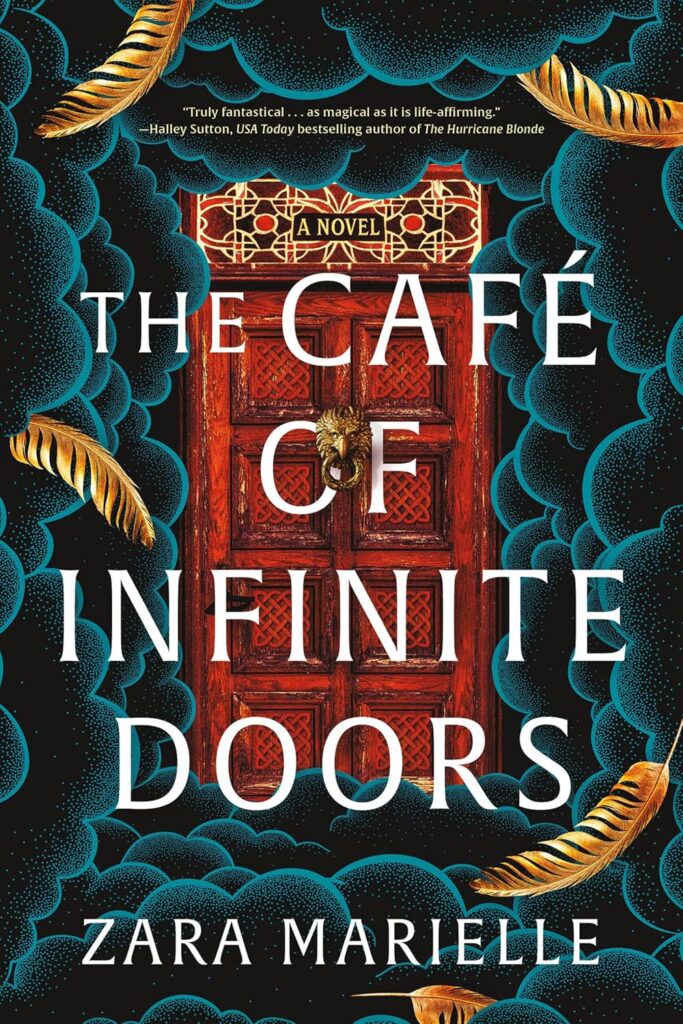
What can you tell us about your book, The Cafe of Infinite Doors? What was the inspiration for this story?
The Café of Infinite Doors is my debut novel. It’s an empowering fantasy about a trapped housewife who secretly takes a job at a magical café, but finds herself entangled in a deadly rivalry between two Scottish goddesses. It incorporates Celtic mythology and takes place in a reimagined ancient Scotland, in modern San Francisco, and in a café outside of space and time. And yes, it has queer characters! Though the subject matter (a toxic marriage) sounds heavy, the novel is both hopeful and empowering, and all about finding oneself and escaping patriarchal expectations. I think it will resonate with anyone who has ever felt stifled by the role society imposed upon them. Anyone who ever longed to break free.
When I think of the inspiration behind the story, I tend to come up with three equally true answers. The first: I lived upstairs from my parents’ café as a child, so I’ve always felt comfortable in that setting. It’s a place where you can go alone and sit quietly but still feel like you’re part of the hustle and bustle happening around you. Great eavesdropping happens at a café. The second: I did my master’s in creative writing at the University of Edinburgh, but even before that I had a tiny piece of Scotland lodged in my heart. (How can you not? The scenery! The music! The accents! The stories! The kilts!) The third: When I started writing this book, during the pandemic, I’d recently escaped a very unhealthy relationship where I’d felt belittled and disregarded on a regular basis. Finding the strength to take myself out of that situation became a fundamental part of my value system, and I wanted to write a story about someone going through something similar, but give her some magic to play with.
As a writer, what drew you to the art of storytelling, especially speculative fiction?
I grew up an only child and until I found improv years later, I was always incredibly shy. Thankfully, both my parents loved reading, and they passed that passion on to me, so I was forever losing myself within the pages of magical adventures. I can’t remember ever not wanting to write! Writing is telepathy. What do I mean? Essentially, the words I have pulled from my brain end up printed on some paper, allowing me to speak directly to the mind of someone who might be hundreds of miles away. I get to paint a picture with words, and readers will see their own version of that very picture, which would never have existed if not for me. How is that not magical? I especially love speculative fiction because I find reality so limiting. Why not bend the rules of the world and examine the consequences? Doing this allows for so many interesting thought experiments.
How would you describe your creative process?
My creative process involves a lot of freaking out. I start with a seedling of an idea—often one that strikes in the middle of the night and leaves me scrambling for a notebook so I don’t immediately forget it. Then, I’ll spend weeks crafting the perfect outline, only to implode with anxiety when my characters start doing their own thing and deviating from the plan. To be fair, “their own thing” is often more compelling and more interesting than the initial idea, but do I simply surrender and change my course? Of course not. I freak out about it, write a whole new outline that fits these new developments, and then go through yet another cycle of torment when it all happens again!
This process essentially repeats itself until I drop dead. (Just kidding). At some point I manage to compile a full draft I don’t hate, and then I send it to my trusted critique group for them to kindly tear it apart. It sounds exhausting, but I’ve learned to accept each explosion of doubt as part of the process.
After my critique group tears the book apart, I rewrite chapter upon chapter, patching the plot holes and tightening the sentences. And when all that is finished, I send it to my agent so she can have a turn at tearing the story apart, too… Once she’s done, I make more changes, and then it’s my editor’s turn to tear things apart! In summary: I’m forever rewriting things I’ve already written, but that’s all part of the game. That’s how you get a polished piece that you can truly be proud of.
What are some of your favorite elements of writing? What do you consider some of the most frustrating and/or challenging?
My favorite part of the process is that initial bolt of inspiration. I love catching it before it disappears, and following it to see where it leads. Inspiration is the best feeling in the world. It’s like running free inside a sumptuous palace and opening doors at random with no idea of what you’ll find behind them. But the palace is your mind, and each door is a new idea. I’m an atheist, but it’s hard not to ask myself where all these ideas are coming from. That, too, feels like magic to me.
I also love those moments when the writing just flows from your fingertips, and you become completely unaware of time and space. This isn’t specific to just writers; I think anyone who immerses themselves in an activity they love has felt this way before. It’s just incredible to look up and realize three hours have passed while you were in this other world, zoned into a completely different reality from the one your body is in.
The most challenging part of the process for me is writing the end of a book. You’ve established all these rules for yourself and somehow you have to tie all your disparate threads into a cohesive knot without breaking any of them. It can be tough! I know some authors who love writing endings, but to me, beginnings are the best. They are full of possibilities, everything is fresh, and things can go in any direction. But the farther you get into a story, the more those possibilities narrow. Finding the most logical, satisfying, and unpredictable resolution is truly an art.
As authors, who or what would you say are some of your greatest creative influences and/or sources of inspiration in general?
This is a tough question for me, as so many of the writers I used to admire have been exposed as truly despicable characters. I’ve had to find myself a new set of heroes. One writer I adore is VE Schwab—she has a way of weaving words into a story that just submerges you. I also love TJ Klune, GennaRose Nethercott, and Alix E. Harrow.
But beyond individual writers, I’m inspired by so many things: music that takes me back to a particular era of my life, like Florence and the Machine, The Kooks, The Smiths, Tegan & Sara, or Enya. The Lord of the Ringsmovies, which are so immersive and beautiful and never fail to make me cry, although to be fair, I cry very easily. The movie Amélie. A short-lived British TV show called Sugar Rush that I watched with my first ever girlfriend when I was eighteen. Fall Foliage. The color of the lake near where I grew up in France. A whole stack of Broadway musicals, with Les Misérables sitting right at the top. The smell of sunscreen. I could literally write for hours about the things that fill my soul with that giddy helium feeling and make me want to immerse myself in the act of creating.
What’s a question you haven’t been asked yet but that you wish you were asked (as well as the answer to that question)?
I’m outraged that nobody has asked me what my favorite animal is. The answer is the wallaby. For those who don’t know, wallabies are like kangaroos but a bit smaller and less beefy. They are delightful. I love the way they propel themselves forward with such grace. I visited Cairns, Australia, a few years ago, and I saw so many fields full of happy little wallabies living their lives in the wild. I love them with all my heart. A close second is the Quokka. If you’ve never seen one, do yourself a favor and Google them. I realize this question has nothing to do with writing, but the world needs more marsupial awareness.
What advice might you have to give for any aspiring writers out there?
I am probably unintentionally plagiarizing this from somewhere, but a published writer is a writer that didn’t give up. It took me years of rejection to finally get to the point where my novel is going to be published. The Café of Infinite Doors will technically be my debut, but it sits atop a pile of predecessors which will never see the light of day. And you know what? I’m not mad about it. Sure, one could see those unpublished novels as “wasted work”, but I learned so much about the craft of writing with every draft, and when I compare those early novels with Café, you can see I’ve really leveled up. The lesson there is you should never stop developing your skills.
But about rejection: it’s simply part of the game. You write your heart out, then pursue agent after agent until one of them finally says yes. Then after more rounds of revisions with your agent, they take your novel on submission to editors, and the rejection starts all over again. If you’re lucky (ie: your novel strikes a particular chord with an editor when they are in exactly the right mood), said editor will fall in love with your book and take your novel to acquisitions, and guess what? It might be rejected there, too. What I’m trying to say is that you need thick skin, and grit.
Sure, some people get lucky. Some people query the right agent immediately and find an editor within days. But that’s a highly unusual scenario. Most of us have to suffer. Of course, for those who wish to write without dealing with all these gatekeepers, there’s always self-publishing. That’s a whole other ball game that I’m not qualified to talk about, since that isn’t the route I chose.
Are there any other projects you are working on and at liberty to speak about?
Alas, most of the ideas swirling around my mind are still filed under TOP SECRET, but I will drop a few random clues that won’t mean anything to anyone, just for my own amusement: sleep disorder, cult, cactus, wagon, pirate, memory.
Finally, what books/authors would you recommend to the readers of Geeks OUT?
If you haven’t read TJ Klune’s cozy, queer book The House in the Cerulean Sea, I would get on that at once. Also, for my fellow millennials who feel betrayed by JK Voldemort’s politics, I recommend Her Majesty’s Royal Coven, a delightfully exciting witchy series by trans author Juno Dawson. Other books I’ve loved, gay or otherwise: Mexican Gothic by Silvia Moreno Garcia, Bunny by Mona Awad, Voyage of the Damned by Francis White, The Book Eaters by Sunyi Dean, and Weyward by Emilia Hart. And roughly a thousand more that I’ll probably think of as soon as I close this document. There are A LOT of good books out there, folks.
0 Comments