
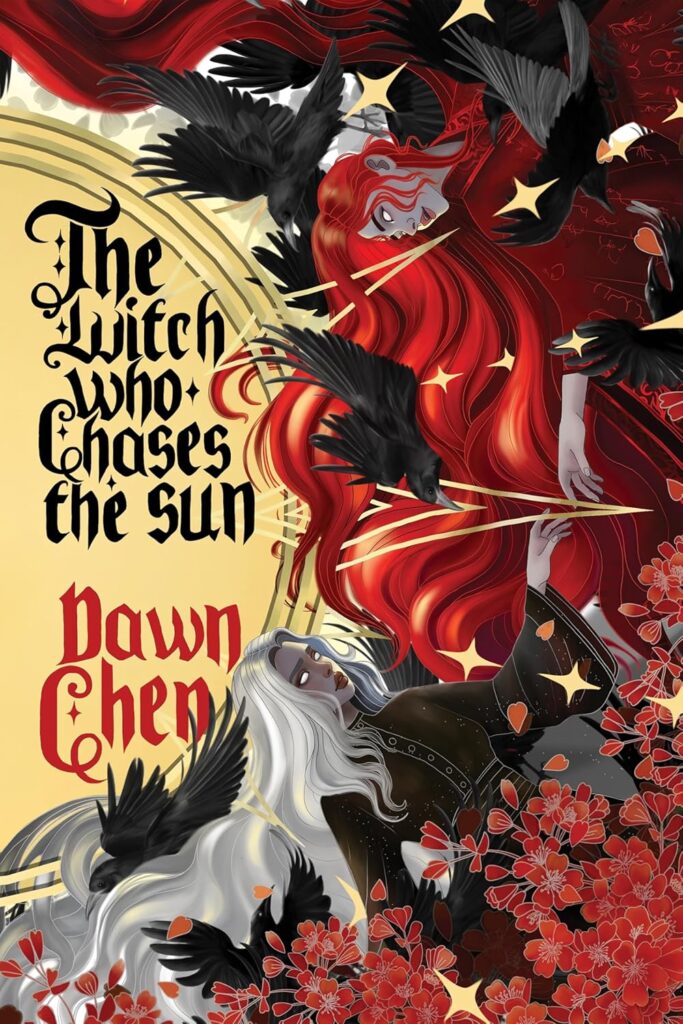
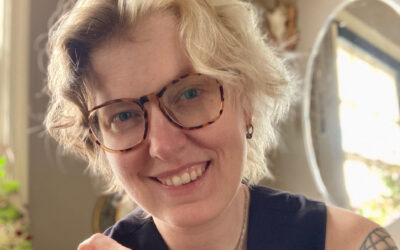
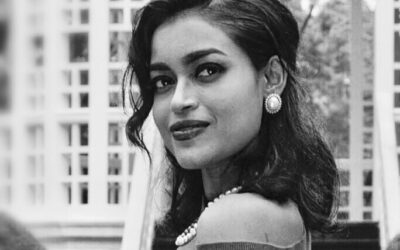
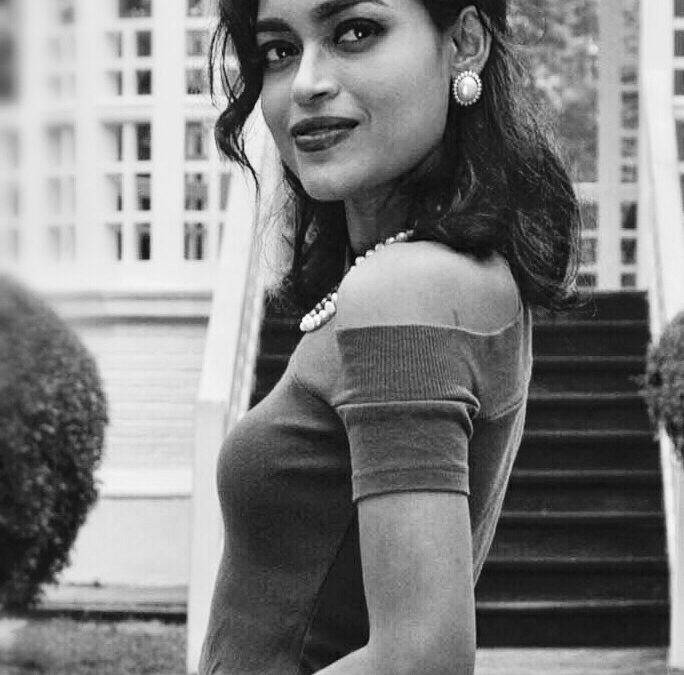
Dawn Chen is a sapphic fantasy and horror author who grew up in Beijing, China. When she was thirteen, she moved to Germany to live with her family. Since then, she has both lived in Canada and UK. She writes in both Chinese and English, wishing nothing more than to keep writing, and has a perfectly healthy obsession with ghosts. She’s the author of the Chinese queer diaspora horror short story collection Dawn’s Cozy Horror Corner, the Chinese-inspired anti-British colonial sapphic fantasy The Witch Who Chases the Sun and the upcoming sapphic vampire epistolary horror novel A Vampire in Beijing.
I had the opportunity to interview Dawn, which you can read below.
First of all, welcome to Geeks OUT! Could you tell us a little about yourself?
Hi, I am a Chinese mainland lesbian author who writes sapphic horror and dark fantasy that often takes inspiration from Chinese mythology and folklore, as well as urban legends and history. I was born and raised in mainland China until I was 14 when I moved to Germany due to my mother’s work placement. For the next ten years of my life, I spent most of my time in the UK, but I chose to return to mainland China and stay here for the foreseeable future. Dawn’s Cozy Horror Corner (2024) is my YA horror short story collection of urban legends that reflect the real life experience of being Chinese diaspora in the West as a teenager. The Witch Who Chases the Sun (2025) is my debut sapphic, character-driven, dark anti-colonial fantasy inspired by a mixture of Chinese and European folklore that deals with the question of if a war truly ends for those who survived through it.
What can you tell us about your book, The Witch Who Chases the Sun? What was the inspiration for it?
The Witch Who Chases the Sun is born from the unresolved trauma of being a queer POC— naming a Chinese lesbian—who spent the majority of her teenage years in Britain, a colonial power that once tried to colonize China because of the demand within Britain for Chinese porcelain and tea. The Qing dynasty China was self-sufficient and did not need trade with Britain, which led to centuries worth of tension that culminated in Britain essentially “creating commerce” by introducing opium into Qing dynasty China, which resulted in mass addiction and eventually lead to the Opium Wars.
Growing up as a Chinese queer person in the UK is a funny experience, because white British people (whose entire empire is built on colonialism) carry the same mindset as their colonial ancestors of believing their society is civilized. They pride themselves on their tea culture, while never acknowledging the fact that identity is stolen and built on the blood of my people. Talking about racism in the UK is different from talking about it in the US, because white Brits will happily tell you that their city is diverse as if they solved racism, despite every museum in London having entire sections of looted and stolen historical artifacts from countries they colonized that they refuse to give back, including Chinese artefacts.
The Witch Who Chases the Sun was first drafted during the rise of hate crimes in the UK against Asians during COVID-19. It was originally—funnily enough—a cozy fantasy, because I wished to comfort myself with the idea of a sapphic interracial couple surviving impossible odds and living happily together after a devastating war. But that soon turned sour, as it felt so detached from the reality I was living in. So instead of a cozy fantasy, the story of TWWCTS erupted from me like a volcano, burning and surprising myself even with the intensity of the pent-up rage I felt after years of compartmentalizing the trauma that comes from having to live in a society of robbers calling themselves civilized while their pride—the British Museum—is built on looted artifacts of cultures they deem inferior. To watch them scapegoat immigrants as a problem, when they themselves are the ones who went uninvited to colonize half the world. That rage is the sole inspiration for The Witch Who Chases the Sun.
As a writer, what drew you to the art of storytelling, especially speculative fiction?
I like speculative fiction because a lot of experiences in real life as a BIPOC and a queer person—also the intersectionality between the two—are oftentimes impossible to describe the full scope of in a short amount of time. Speculative fiction asks the reader to suspend their preconceived notion of reality and embrace the speculative elements in a metaphorical sense. And to be very honest, the reason why I mostly write horror and dark fantasy like TWWCTS is because that is the only way I can conceptualize the trauma of my lived reality to others.
To me, speculative fiction is not escapism. Instead, it is always meant to serve as a mirror, and that mirror is sometimes the only way I can get readers who might never have experienced the horror of living as a BIPOC queer immigrant, and may not know what it entails to live in a white-majority, racist society that has white supremacy baked into its very foundation, to understand my existence and point of view.
And perhaps even more importantly, it is a rallying cry for my fellow marginalized, intersectional queer people who might walk around the world with similar scars inside them. That’s my perspective on storytelling. It is a safe outlet for people whose voices and feelings are drowned out and suppressed to keep the majority’s comfort. It is community building. It is validation. It is healing by not turning away from the painful things, by not sugarcoating what we went through, and still to know that we are not alone.
How would you describe your creative process?
I’d say it’s like being possessed. Until I finish writing the story, it is like an exorcism where something is banished from me. The story might have poured out of me, but they grow like they have a will of their own. And I try to ensure it stays true to what it wants to say, but also to cut it apart from myself enough so I am not consumed by it as well.
What are some of your favorite elements of writing? What do you consider some of the most frustrating and/or difficult?
I love writing stories that make people feel something. I think if the story manages to make you be in touch with your emotions, then it is successful. And my favorite element of writing is trying to imbue that emotion into my story. What I find the most challenging is finding a story where the emotion that I wish to express through the story can remain undefeated by all the self-doubts. Because to write a longer form story and to publish, it means one has to wake up every day committed to the vision and the emotion one wants to convey, and that is harder than it sounds. To believe in a fictional thing that is born purely out of yourself for years on end? To make something solid out from something as turbulent and ever-changing as the daily ins and outs of life? That is difficult. Consistency and dedication to a story is difficult.
As an author, who or what would you say are some of your greatest creative influences and/or sources of inspiration in general?
A: I’d say RF Kuang is the greatest influence on showing me as a writer as to what fantasy as a genre is capable of when people don’t pick up non-fiction anymore. The Poppy War trilogy and Babel showed me how fantasy can truly impact people who would otherwise not learn the full extent of historical atrocities like the Nanjing massacre done by the Japanese in WW2. Fantasy almost acts as an ice breaker that make the public who thought they were going into something purely for entertainment to truly be in touch with history and then become more in tune with the ugly parts of history they wish to forget—or were never taught about.
Other than RF Kuang, I’d say Qiu Miaojin—the Taiwanese lesbian writer whose works Notes of a Crocodileand Last Words from Montmartre are foundational to the Chinese lesbian community—is the greatest influence stylistically wise. The semi fever-dream-like prose that breaks conventional structure of a linear narrative to challenge the reader to feel the full extent of the fracturing state of characters/narrator’s perspective in a story is always something I find bold and admirable.
Aside from your work, what are some things you would want readers to know about you?
Not really about me but more about my community? I want readers to check out more danmei/baihe (Chinese queer works by writers in China) translated into English, because they are the community that facilitated my love for writing and made a safe space for my coming out as queer so much easier than a lot of other people. I want readers, who might like TWWCTS, to use it as a conduit to check out more translated danmei/baihe titles available in English so that there are more chances for our queer stories to get the recognition they deserve in the English publishing space.
What advice might you have to give for aspiring storytellers out there?
Write for yourself as much as you want as long as your writing is not actively hurting any real-life people. Be experimental. There is no standard form of writing that is better or worse. Language and fiction styles change over the decades and centuries. Writing is a performance without an audience. Do not overthink audience reaction, don’t try to please anyone. A story that is true to you might not be understood by everyone, but it is more important for it to be read by someone who has been searching for the story you wished to tell their whole life.
Are there any other projects you are working on and at liberty to speak about?
Yes, I am working on the revision for A Vampire in Beijing, which is an epistolary sapphic horror set in contemporary China about a Chinese sapphic vampire who is navigating the home she left behind as well as the Chinese queer creative community, all the while she’s writing bitter love (hate?) letters to her ex-girlfriend, who is also her white British vampire sire. It is set for release with Contrarian Publishing in 2027.
Finally, what books/authors would you recommend to the readers of GeeksOUT?
The Poppy War trilogy and Babel by RF Kuang (grimdark alternate historical fantasy), Last Night at Telegraph Club by Malinda Lo (YA lesbian historical fiction set during the Red Scare in US), The Siren Queenby Nghi Vo (sapphic magical realism historical fiction set in old Hollywood), If You Still Recognize Me by Cynthia So (YA contemporary sapphic coming of age story), A House Unsettled (BIPOC sapphic haunted house horror), The Witchling’s Girl (Dark fantasy with one of the most unique fantasy worldbuilding I ever read about), The Witch’s Heart (Norse myth retelling)
0 Comments