
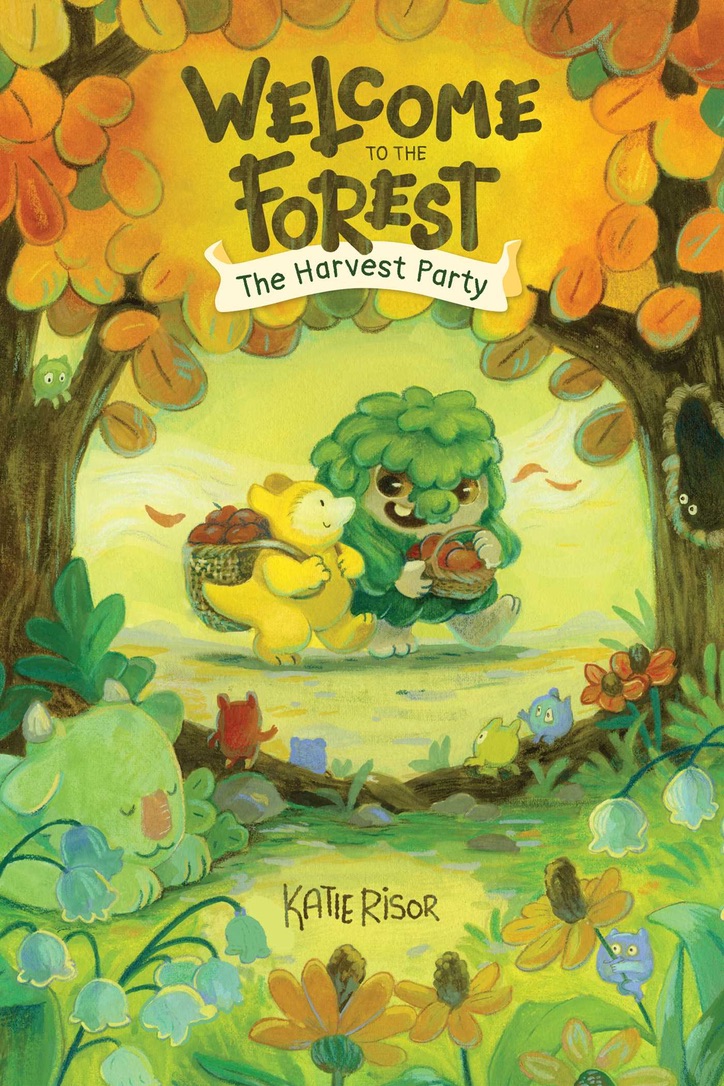
Children’s book author and illustrator Katie Risor is an artist of whimsy and wonder whose work maintains a loveliness that glows off the page. Welcome to the Forest: The Harvest Party, book one in her debut and seasonally-themed series was released back in August of 2025, with the next installment The Lake Trip, set to drop this June. Still in the grips a deeply snowy winter in New York, the Texas-born, now Syracuse-based Katie and I chatted about the series, the creative process, beloved books from our youth and more. This interview has been edited and condensed for clarity.
Your first book was published in August 2025. It is called Welcome to the Harvest.
Welcome to the Forest: The Harvest Party.
Welcome to the Forest! I have that written down, literally [it’s in front of my face].
I have a plague of, like, picking names, titles that are too long. When I was making the books, before I pitched and everything, I was just calling them, like, the creature book and the Fall book and stuff. I thought that somebody, like, when I got a publishing deal would have better ideas for titles. Um, and they didn’t. They just let me do whatever. I’m like, why are you letting me pick this? This doesn’t seem right.
I thought we were professionals here!
Yeah, I know. I was like, “I’m just a guy! Y’all are supposed to know what’s going on.”
That’s so funny.
The book series started because I had been painting these creature designs. And I was taking an intensive comics course with my now agent, Janna Morishima. She runs Kids Comics Unite (KCU), which is a comics community online and they run a bunch of courses, but this was at the beginning of it. And during that, I was doing these calls with her, and she told me that she really liked my creatures. I had been painting them, and I liked them a lot, but I didn’t have a big plot or, like, a big story that I wanted to tell. I just liked drawing these little guys and I would think of scenarios and stuff for them, but not like a big story. I didn’t think that it would be, like, something viable for a book, you know? But she told me that she really liked it and that if I made a book with the creature characters, that she would be interested in representing me. So in that call, we brainstormed a bit, and she came up with the idea of seasonal themed books, doing something for fall, and kind of nudged me in the direction of if I would be interested in, like, the early reader zone, because I have been a fan of Frog and Toad and stuff like that. And I was like, oh yeah, I think that would work. As I was working on it, it just kind of evolved into this comics thing. Which wasn’t really originally my plan, but it just kind of happened.
What was the original plan?
To be early reader, I had this vision of a narrator saying stuff, but then stuff would also happen in panels, which is kind of what happens in the first book. In the second book there’s not as much narration. It ended up going a little bit more comic-y. But I also didn’t really know what I was doing. Like, I hadn’t read a lot of that age range yet. It went through a lot of phases. Originally there were four stories. And then one of them, it was just too big and like couldn’t fit in there. So it evolved a lot. After I got with an editor, she helped hone it in [more].
Throughout the series, as you release them, are we following the same characters through each story?
Yes! There’ll be some, like, continuity things, like, in the harvest book, The Harvest Party, they meet Shadow (one of the creature characters) for the first time, but then Shadow’s in the rest of the books. So you don’t have to read them in a particular order, but there’s small through lines that you can notice.
How was developing a story like out of just, you know…
Out of vibes?
Out of vibes or just like, scenes. How did those scenes come together in a story?
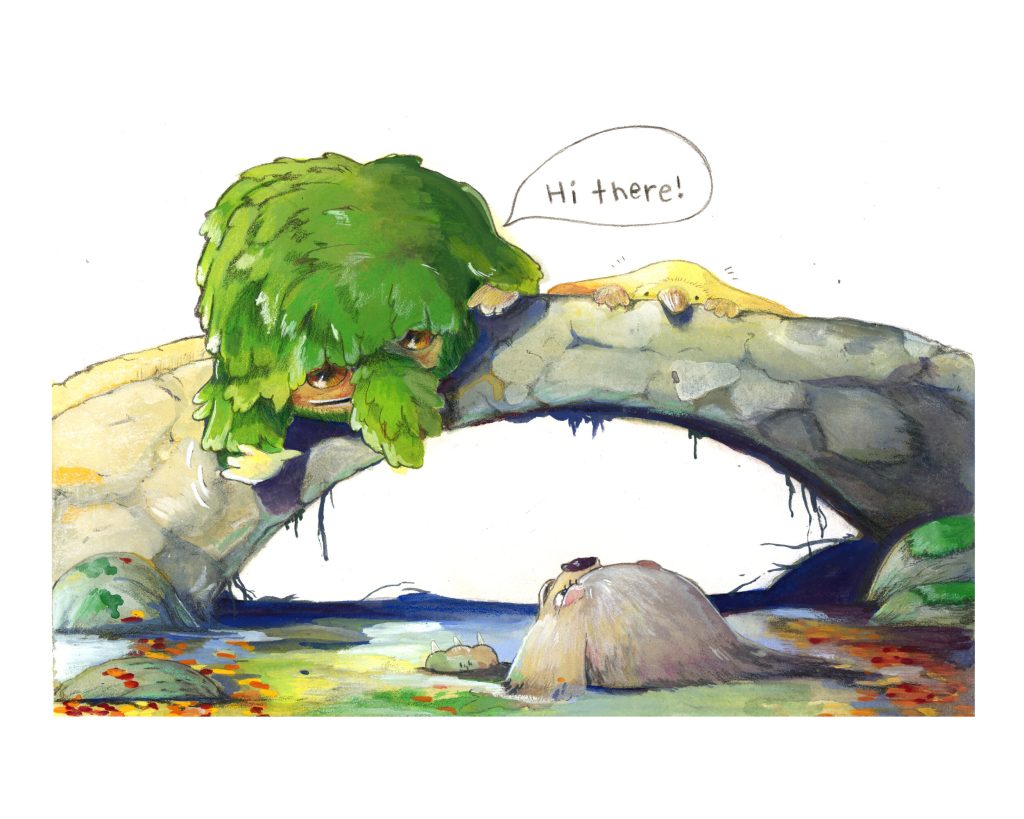
Yeah, it was really difficult at first, because writing is really hard. I eventually figured out how my brain works and how the process works. It usually comes down to, I will just like draw something kind of out of nowhere and be like, oh, that’s funny. What is the story there? Like, I drew this picture, actually have it on my wall, I can show you. [brings picture closer to the camera] I drew this picture of Wallace (another character from the books).
Oh, cute!
I wanted him to be looking at something. What’s he gonna look at? I put some eyes in there. And then that kind of turned into, maybe that’s the shadow, the shadow is like in the darkness in there. Then that turned into Shadow being a character. So stuff like that just kind of happens. I do a lot of like back and forth of just doodling in my sketchbook and ideas will come to me as I’m drawing. Then piecing that together into thumbnails and script and stuff. It’s gotten a lot easier.
You had mentioned Frog and Toad as an inspiration. Is that an inspiration just illustratively? These are classic characters and stories; I have very heartwarming feelings about them from childhood. Were those helpful in that way as well?
Yes, definitely the cozy, nostalgic vibe. Parents will remember Frog and Toad. Maybe this will remind them of things like that for the parents, but it’s something new for the kids. Also the friendship dynamic in Frog and Toad of their friends, but that you have contrasting personalities that cause tension. That’s where a lot of the story elements come from in my stories.
What were some other inspirations you went to to draw from for the creation of the series?
Stuff like Fraggle Rock and then like more modern books, Mika Song’s series, Norma and Belly. I looked at a lot for how to format for the age range and panel size and what I could fit in panels and stuff like that. As far as, like, artistically goes, the reason I started painting with gouache and stuff was because I just was really inspired by old animation and Miyazaki movies. Like, background paintings and I wanted to figure out how to paint like that. Which wasn’t the best move for a comic necessarily, but I couldn’t separate that from the creature characters. So that’s where we’ve ended up.
Can you explain a little bit in the most layman’s terms possible what gouache is?
Yeah, so gouache is an opaque paint that is reactivatable with water. It’s made of the same stuff as watercolor, which is pigment and gum Arabic. Acrylic paint has a plastic binder, so when it dries, it, like, seals into plastic, basically. With gouache, it reactivates with water, so that doesn’t happen. It also dries matte, which means it’s very easily photographed and scanned, so a lot of illustrators use it. And before we had digital art, gouache was the main thing used for, like, advertisement and graphic design, and then very heavily in animation and animation backgrounds, and it’s still used for that, like, for anime still. And then like SpongeBob still paints their backgrounds with gouache.
When did you start getting into gouache?
At the end of college, this was like 2016, 2017, I graduated in 2018. But around like 2016-2017, I was starting to get more serious into pursuing illustration and learning and practicing. I got into watercolor really heavily, and that kind of put me on the path of more traditional art and not digital art. I enjoyed watercolor for a while. I did my first freelance books for self-publishing authors with watercolor. Gouache was kind of starting to get popular online a little bit, and finally, I was like, oh, this is how they painted animation backgrounds! I grew up in kind of an artistic family because my mom was a painter, my grandma was a painter, and my grandma was taught to paint by my great-grandma. Her mother-in-law. But they were oil painters and acrylic painters, and I was like, I’ve painted with this stuff, and I know this is not what they were using for animation. How are they doing this? I just started to want to have the opacity back and being able to paint on top of things and have a little bit more flexibility and freedom, because watercolor, you really have to plan ahead and do everything in the right order. And, um, the ADHD brain doesn’t always want to do that.
It’s so interesting just thinking about your lineage of artistry and I guess how animation and TV and certain films had an influence or would have had an influence on you and your direction and your artistry as opposed to your mom or your grandma or your great-grandma in terms of how you would want to go about it and use it. I find that really, really fascinating.
And then also the books that I had as a kid, like, my mom collected little golden books, so I had a bunch of those. And those are very like, mid-century style illustrations. And so now I look back at a lot of those for reference.
Yeah, God. I was in a thrift shop a couple years ago and saw a whole pile of them and it just took me back to my childhood. They’re fantastic. And yeah, they just really place you in a time and place and there’s such a nostalgia associated, maybe for us because we grew up with them. Do they publish them anymore?
They do still publish them!
Oh, okay, wow. That’s so cool.
Somebody, let me paint a little golden book!
Yeah!
They do a lot of licensing tie-ins and like, celebrity things now. They kind of always did Disney books and stuff, but now there’s Barbie and Star Wars and stuff. It’s crazy.
That is crazy. That’s crazy to think about. Are they still using the same style?
They vary. It’s all kinds of different styles. I feel like a lot of them, because I would guess, I do not know this for a fact, but I would guess that they don’t pay them that well. So a lot of them have like that kind of more standard, digital style you’re used to seeing. Because Golden Books originally, like, was founded on being cheap to produce and cheap for kids to buy. They were like ¢20 right?
Right, because kids get messy, they rip stuff up. So yeah, that makes a lot of sense.
Yeah, so I think they might still be kind of, you know, doing that. I think it’s good to have a variety of kinds of books out there. I liked that the Andrews McMeel books, my publisher, even though they’re nice, hardback books, but they’re only $12 and you have like a whole 80-page graphic novel for $12. Whereas like a like a premium picture book can be like, $30.
What are what are some modern inspirations for you? Who right now is making stuff that you’re really into and excited about?
Definitely John Klasson, for picture books, and Matthew Forsythe. I really love his illustration style and his writing style for sure. In comics, there’s a lot. I already mentioned Mika Song. Phoebe Wahl, her Little Witch Hazel book was a really big influence. When we were just starting to pitch and my eye was kind of struggling, her book came out, Little Witch Hazel and I read it and I showed it to my agent and I was like, “Look, somebody did the thing.” At that time, I had two versions of the pitch that was like, sized for picture book or sized for comics. Who else? [Pauses and looks at bookshelf]. Beth Ferry, I think, Fox and Rabbit, that was one that I read early on. Then personally for me, getting into children’s publishing, I had an epiphany moment when I saw Be Prepared by Vera Brosgol in my comic book shop, because I was looking at all the comics. I was like, I like comics, but I don’t want to draw like this, you know? Then I found that book and was like, oh, wow.
Was it with this book that your kind of artistry and love for comics collided for the first time or had you been working on something similar previously?
I dabbled in comics, in college, like, trying to make web comics. Then I had joined the KCU intensive because I was working on an idea for a middle grade graphic novel. I had been doing freelance for self-publishers. As a kid, I wrote a lot and had been trying to write a novel when I was ten and stuff like that. I kind of stopped during college, but I finally had this moment of, I need to get back to writing, and I was hesitant because I knew it was going to be really hard because I hadn’t written in a while. So I just, like, laid on the floor until I had an idea and then I started working on it. When I started working on it, originally I was trying to make a picture book. And I was like, ah, shit, this is like a graphic novel, isn’t it? So I started on that when I was taking the course, but I was painting these creatures at the same time and was going to maybe put some future characters into that book. But like I said, Janna was interested in my creature characters and was like, “This one still needs time in the oven, but if you do this, I’ll represent you.” So, you know, I pivoted.
I did read somewhere that you lie on the floor and close your eyes to get your ideas.
Big fan of lying on the floor!
Do you light candles? Do you put anything on the floor? You just feel your body on the ground and wait for something to flow through?
I don’t really do candles when I’m working, but sometimes I have my whatever, music on and then I lay on the floor. Other times it’s like, I’m frustrated and I need to reset. It’s really versatile.
There’s something very meditative to it. When you’re doing that, and ideas are coming to you, when do you know that it’s an idea that’s gonna stick and you want to play around with?
When I feel excited. I close my eyes and visualize because I see images in my mind, like constantly. I don’t know how people who, what’s it called, aphantasia, who don’t see anything in their head?
Yeah, same. It makes no sense to me. I also hear voices and like different accents and stuff and some people don’t. And it’s like, what?
Imagine closing your eyes and there’s nothing going on.
Oh that’s terrifying. Absolutely terrifying.
Sometimes I’ll literally see a character and be like, I gotta do that and figure it out. Like, that’s how Wallace happened. And now I’m better at visualizing and can see it more clearly. But back then, I’ll, like, have an idea for a character and it’s kind of hazy. I can kind of see them and then I have to work it out on the paper and figure out what that design actually is.
Does the story around them start happening at the same time? Like, if this creature looks like this, then is there some kind of narration going on?
I feel like the designs show up more easily and then I have to kind of discover what their personality’s going to be like. So, I’m working on the winter book right now. And there’s a new character every book. My original idea for this book was there was going to be a bird character who shows up. Originally, he was gonna be like, a robin and he was gonna have migrated south for the winter. And then a snowstorm happens. And I was really struggling to come up with an idea for how this character would look, and I was putting it off. Then when I finally had to start working on the winter book this year, all of a sudden, I was thinking about it, trying to draw Robins. Then, I guess I remembered, like, drawing owls when I was a kid or something. I was like, what if they’re an owl? So I started Googling owls and looking at different types of owls to get an idea of what they would be. And I came across Great Grey owls, which are snowy owls, but they can also live in warm climates. So then I thought it would be funnier if he was an owl, but he like came from a snowy place because he was tired of the freaking snow. So he came south to like…
He was a snowbird [a lovingly deragatory term south westerners use to describe people from the Northeast who relocate to warmer climes in the winter, leave in the summer, and drive very badly in between].
Yeah! Then there’s a snowstorm, and then, because it’s a freak snowstorm, none of them have had snow before, so then he’s like the snow advisor and also like, “You’re never going to be able to handle the snow.”
Oh, I love that. That’s really funny.
And I was like, ah, that’s a lot better than the robin. So sometimes if there’s something that’s a sticking point, then eventually, I’ll break through and realize the direction I was going was wrong, and, like, I had to figure that out.
Definitely the cozy, nostalgic vibe. Parents will remember Frog and Toad. Maybe this will remind them of things like that for the parents, but it’s something new for the kids.
Sometimes it just takes a little time, like just marinating.
I’ve learned to be able to tell when I just need to wait and let it be in the oven for a while and then my subconscious will deliver an idea to me eventually. I kind of rely on that a lot. Sometimes just trying to sit and think about it and figure it out, is very exhausting and frustrating and doesn’t usually work.
Yes, hard relate. Would you say that maybe not having patience with your process is the most frustrating part about your process or something else?
Oh, yeah, actually, I think I might say that especially, when I’m on crunch time. It’s also a lot harder to write when it’s an assignment than, you know, when you’re just doing it. I ran into that with the second book of just feeling really stressed about it and feeling like I didn’t have enough time or I wasn’t allowing myself to chill out and play around. I was just like, I just need to make the book, you know? And being impatient with myself because there was a time crunch. And then procrastinating because I feel stressed about it.
When you get in those moments and you identify what’s happening, what do you do to take care of yourself and bring yourself back and be like, “Nope, this is just where I’m at in this process. I need to like, take the pressure off of it.”
Yeah, suffer mostly [laughs all around]. I’m definitely still figuring that out, I guess. My first book, the first book [of the series], I got the deal. I had been working on the book for, like, four or five years at that point. Because of writing it and then the pitching process, we actually had a deal on the table with IDW. They had a bunch of layoffs and my editor got fired. I had been really excited to work with her, and they kind of strung us along for a while, and then the deal fell through. It worked out because my deal with Andrews McMeel was a lot better. But it set me back like a whole year. We were literally about to sign the contract. Then I had to redo the pitch and pitch again and all that and another year. By that point, I was just excited to have my chance and make this book that I had been raring to do. And then when we get to the second book, it’s like, oh, I did that now. What is like the rest of my life gonna look like?
Yeah, and also it’s so much less time to work on it. Like, four or five years, you can really spread it out and balance your life in different ways and work on other projects, you know. So, this first book was published August 2025, this next book is coming out June of this year, it’s not even comparable the amount of time you have to get it done.
And I came into, like, the pitches with some summaries for the other books. So it wasn’t completely from scratch. I already had the characters and the world, so I kind of knew a little bit what I was doing, but yeah, definitely a lot different. And I couldn’t like, sit and work through the thumbnails to figure it out.
When you’re pitching a children’s book or a comic book, do you do it on proposal? Is there a specific way you have to pitch since there is this visual element to it that would be different from your normal book proposal or agent querying process?
For picture books, usually what you do is you make a book dummy, which is kind of like a rough draft. If you’re an author/illustrator and you’re making a book dummy, you rough it all out and then you finalize like, two to four pages. And make a nice style image or whatever. For a comic, in my case, I did draw a whole book dummy because it was originally pitched to sixty pages because everybody in the freaking world told us that it needed to be sixty pages. And then we got with Andrews McMeel and they were like, you want to do eighty pages? I was like, oh boy, would I! But because it was not that long, I did a whole, full book dummy. For longer comics, like a graphic novel, because a lot of writing happens with drawing, it would be unfeasible to draft the whole thing. So you make what’s called a pitch packet, which has one page for a summary. Sometimes, depending on how long it is, a very long detailed summary or outline can also include script sample pages, and then a sample chapter with some finished art in it. And then a page with comp titles, books that are similar and prove that it’s something that you could do in the market and whatever. And then something about you. It’s kind of similar to if you were gonna pitch like a nonfiction book. I don’t know how it is with like essay books, but nonfiction books of being like, I still need you to fund me to do all the research for this thing, but like, here’s my idea and why I’m qualified.
Yep, yep, absolutely.
But it’s interesting with comics because you could be pitching with a couple finished pages and whatever, but maybe you don’t have the full book written yet. Like, you don’t know what the whole story’s gonna be, and you might be saying one thing in the summary to get your book deal, but maybe it turns out a different way.
Completely. I have a memoir mentor who’s always like, “If you sell the book on proposal, that’s not going to be what the book ends up being most of the time.” It’s going to be a completely different beast and usually editors know that when they’re signing you.
And that was hard to get my mind around and feeling like, you know, really perfectionist about it of like, this is what I got to figure out what the book is before I sell it. Now I’ve accepted it because I can draw and paint a bit faster and I don’t feel as precious about it. But at the beginning of being like, I’m going to make all of this art, and it takes so long and so much effort, and then it’s probably not going to be in the book. Like 99% probably won’t be in the book. That’s tough.
Yeah, yeah, it is. You have to do so much work that does eventually get cut for the real story to come out. I think it’s one of those things about the creative process that I think people really don’t fully understand because like, you still have to make all that work to get to where you’re going. But it is a lot of work. It’s a lot of resources to get it to that finished place.
Especially with writing. I think the average person does not understand what writing is. I wish that we had a word, like, another verb for [it]. Because you say writing, people think sit down in front of computer, type, type, type. That’s writing, right? But like, that’s not really writing.
Nope.
There’s so much more other stuff that you gotta do before that point. I wish we had another word that was like plotting and figuring out things.
Oh my god, plotting and daydreaming. I mean, my process, like, I don’t lie on the floor. I literally pace around like a crazy person because my brain has to move for characters to talk to each other or figure out where to go from one place to the next, you know. It’s that bilateral stimulation. Then you do that for however long and then you sit down to either handwrite or type something up and it can like take so long to even shift into that mode, there’s all this transition period that has to happen. It’s a full body experience.
Totally relate.
It takes over your life.
And so much of it is internal and not quantifiable to the outside onlooker that you feel like a faker. Like, I’ve been sitting here thinking about my stupid little characters for four hours, and that was working, I guess.
Yeah, and have nothing to show for it.
I have absolutely nothing to show for it. Or, like, for drawing, figuring out thumbnails. It’s like, here’s the squiggle. I’ve drawn fifteen squiggles that you don’t know what it is. I know what it is, but I can’t show it to anyone. Then do more work to make it be showable.
I follow a very fun artist on Instagram, Java Doodles. I remember one post, this must have been a year ago or something where I guess he’d been getting comments about how simple his Java character is. And he was like, You guys have no idea what it took for me to figure out this character. Yeah, it looks very simple because of my style, but the work to get to [that], you have no idea what you’re talking about.
Yeah, making very simple characters and simple designs is a lot more difficult than people realize.
People don’t realize, like, how much work it takes to make something seem seamless.
Yes. For sure.
When something feels very simple, you know that…
It’s because there were like, twenty-five other versions that weren’t that simple.
Yes.
You’ve been doing a lot of editing to pare it down. It’s not like you start out simple and add things to it. It’s kind of like, chipping away at an ice sculpture or something.
Big props to sculptors too. Like, my brain does not even work like… I don’t even know how a person does that. Shifting over to artistry in general, you mentioned you come from a very artistic family. Was it ever in question that you were an artist? Was it just kind of like, Yeah, obviously this is just what I do. Everybody in my family does it. Let’s go!
Yeah, none of them were professional artists. But I was very lucky to always have very supportive parents about whatever I wanted to do, but also the bar was very low. It was just like, [if] you don’t go to jail. Good job!
That’s great! [laughs]
Yeah, which was nice. And also, I didn’t have the pressure of worrying about stability or whatever because my parents did not follow their dreams. Like, my mom didn’t become a fashion designer. My dad didn’t become an astronaut. And they’re still miserable. So I might as well try and be miserable doing a thing I like instead. But I wanted to be a published author since I was, like, ten. I was really mad because, like, the freaking Aragon kid, he got his deal at thirteen, so that made me delusional. And for a while I was like, do I be an artist or do I be a writer? Because I didn’t know what illustration was, really. In the northeast, there’s a lot of illustrators around and people seem to know what’s going on, but in Texas, there’s not even an art school, you know? So there’s no illustration program to be had. So I didn’t really know what it was, even though, like, I liked illustrated books. I understood that. But then it turns out you can write and draw at the same time. Make picture books.
You can and you’ve done it! You’re now a published author and illustrator.
I did it! I published a book.
Yeah, it’s amazing. It’s huge. So, what was that like in Texas and having these interests and this desire to move toward that?
I would say the city I grew up in, San Antonio, is fairly artsy. They have an appreciation for arts and culture, but there’s not, like, a big publishing or entertainment hub. I was fortunate to have a very good art teacher in high school who actually taught me things. So that was good. I didn’t know that I wanted to pursue illustration necessarily when I went to college. I was also into video production and animation. Not being an animator but like, production design or something like that. I went to the University of Texas in Dallas, and I did a program called Arts and Technology, which is kind of a 3D animation and game design focus. They also had video production and stuff, which is kind of what I was interested in. I didn’t really expect whatever degree I got to get me a job. It was just mostly to, like, check the box and also, I might learn something and that could be applicable later. During that, I took a pre-production, storyboard class, and it was so fun. It was my second semester, and I don’t remember anything about the rest of college, but I remember everything about that class because it was fun. I took, like, one animation class, 3D animation, and I was like, I could probably be good at this, but I already have all these skill points in drawing, and I don’t really want to be a cog in the machine. I want to make stuff. So I had thoughts of, you know, doing storyboarding and that kind of thing, but my skills just really weren’t there yet in college. I hadn’t really learned that you couldn’t just ride on talent, and you had to do the work more. So, I don’t know if that answered your question or not, but that’s kind of how we ended up where we are.
Yeah, yeah. I mean, that makes a lot of sense.
Also, illustration I can do freelance from anywhere. But pre-COVID, the only way in [was] like, you get a Pixar internship. My college was run by guys at Blue Sky, which is a 3D animation production [studio] in Dallas. And they made Rio and… I think, I don’t know if they’re dead now, but they got absorbed. They got bought by somebody. Anyway, so it was gonna be like, you could work there, you could work at Blizzard, and that’s kind of it. But then they started pushing towards teaching the pre-production students to doing commercials they had for companies and stuff, and I was like, “boo,” you know?
So what brought you from Texas to New York?
So, end of college, my partner didn’t know what he wanted to do, and then he decided he wanted to go to jewelry school, which turns out they have a jewelry school in Paris, Texas, which is in East Texas. And it’s like, the best jewelry school in the country, who fucking knew, right? So, kind of a shithole, but you need to rent. So when we were looking at it, seeing how cheap the rent was, I was like, I have some money, I’d saved up, maybe I can transition into doing freelance because I’ll have a little bit of buffer. So I did that, right? And then after he was done with jewelry school, the plan was to move back to my hometown, which we did. But then my mom died, and a year later, my dad died. I was getting the ball rolling with publishing and stuff. I had my agent, and we were submitting and all that, but I wanted to move because my parents had just died. I wanted to leave. I saw this, like, vision of my family, not the best with health, not the best with communication. I just saw this vision in my future of, like, endlessly sitting in hospitals and dealing with this forever. So basically, I convinced my partner to [move]. Now this is gonna be on the internet, like if my family reads it. They probably won’t, but that’s fine. They were very supportive of what I decided to do even though they were sad I wanted to leave. I think they understood. But I used him as an excuse because he wanted to move up into management. [Like,] look for a job so that we can use your job to move and one ended up coming up in Syracuse. [I] didn’t know that much about the city, but did a lot of research, and house prices were really cheap, a lot cheaper than in Texas. So, we kind of saw that as an opportunity that I would get to be somewhat closer to publishing and everything. Not super close, but closer than I was in Texas. And also, like, get to buy house. And it’s worked out pretty well. We like it here.
One thing I read, [said] you’re very interested in folklore, and Texas folklore as, an inspiration.
You dug deep to find that!
Is there some inspiration from being in the New York landscape and some New York folklore influence [for Welcome to the Forest]?
For these books, not the folklore so much as just the nature. Because I was doing the Fall book purely on my idealized version of what Fall is, never [having] experienced, like, real Fall, you know? I got to move up here, and as I was starting to work on it, going to apple orchards and then now the winter book, obviously, now I know more of this experience with snow. But I am interested in New York history and Texas history. I think [they] are a lot more similar than people realize because New York State is very big, not as big as Texas, but we both have these areas that were sort of once very prosperous and now aren’t. The Rust Belt in Texas, there’s a lot of small towns that used to be little boom towns because they were on railroad lines. And then all of the railroads, like, stopped and those towns are dying. But there’s still families there who have been living there for, like, 300 years at this point. So I moved up here, and I started learning about the north country and the Adirondacks and stuff. I find all that very, very interesting. And of course, the historical connections to the Revolutionary War era and stuff like that, I do find very interesting and it seeps in in different ways.
As we’re wrapping up here, with the first book in the series, what’s going on with these characters, who are they? And as we’re awaiting the release of this next one in June, what can we expect on their adventures?
The first book is called The Harvest Party, and it is about these creatures who live in the forest, and they’re kind of adventurers, right? There’s Wallace, who’s a little yellow guy. He’s kind of nervous and shy. There’s Mossman, who’s the one who looks like his name would be Mossman and he’s the boisterous ringleader. And then there’s Grumpkin, who’s a mute buffalo guy, and then they meet Shadow. Each story is a little seasonal adventure, but they connect through leading up to whatever the final story is. Then the Harvest Party is the party that Mossman is going to throw. In that, we have some personalities clashing, and the second story is about apples. Grumpkin meets Shadow, they fight over an apple, and then it results in friendship. For the second book, another character, a dog named Fiona, gets invited by another friend to come visit her at the lake. She brings along Wallace and Mossman, and they go on a camping trip to the lake. They meet this new character, her name is Sue Ellen, and there’s a little bit of, like, “What’s Sue Ellen gonna be like? Is she gonna be like us? Is she gonna be different?” She ends up, of course, being different than what they expected. There’s a story about fishing that’s very fun, and a story about a day on the lake. Basically, like a picnic.
We’re really looking forward to the drop of this new book this summer. Is there anything else that you’re working on or your curiosity is leading you to? Do you even have time to play in other mediums or do other things right now?
I do have time, trying to make time. I want to sell more books and do more things. I’m working on a pitch called “Cats Around Town” that is a wordless picture book kind of comic. The idea is this town filled with cats, and you would get to see different cats doing different things throughout the story. I’m excited about that. That’s next up on the things I’m trying to pitch this year. But I realize making comics is very difficult and maybe I don’t need to do all of the process all the time. So maybe fit in writing some scripts to sell as just an author. I’m also considering turning that other graphic novel that I was talking about maybe into a middle grade prose novel with, like, illustrations in it instead of a comic. So that’s what I’m trying to do, but then I also am totally open and interested in doing illustrator-only projects. I would really, really love for the art director at Pokémon or whatever to let me paint some Pokémon cards.
Nice!
That’s what I would really like.
I love that. Let’s put it out there, put it out in the universe, make it happen.
I would really love to do board games and card illustrations. I think it would just be fun to get to paint little objects, characters and stuff without having to worry about it being a book.
Yeah, that’s awesome.
I guess the only other thing is, that I’m really looking forward to doing more in-person speaking events and school visits. Stuff like that. If anybody wants me to come talk to kids about comics or do a gouache demo, that kind of thing. I have info on my website and would love to discuss.
For more information on Katie, how to get in contact with her, and where to buy the books and her other work, visit her website https://www.katierisor.com/

0 Comments