
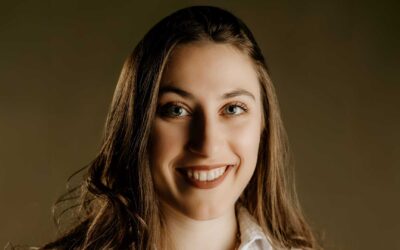
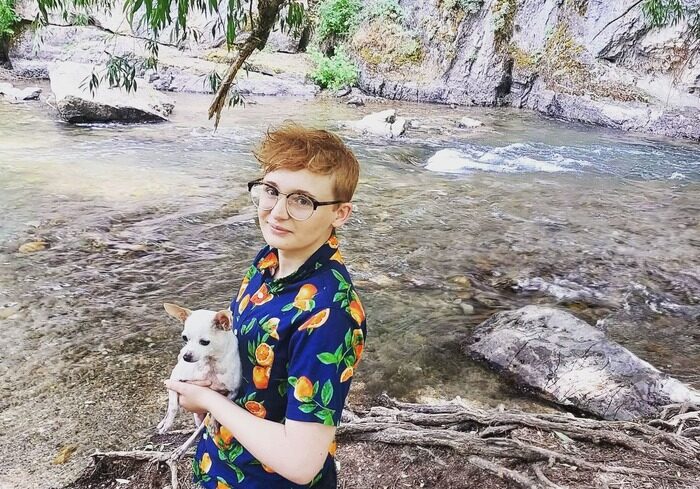
CASSANDRA KHAW is an award-winning game writer, and USA Today bestseller. Khaw’s work can be found in places like Fantasy & Science Fiction, Lightspeed, and Tor.com. Khaw’s first original novella, Hammers on Bone, was a British Fantasy award and Locus award finalist.
I had the opportunity to interview Cassandra, which you can read below.
CW: Mentions of body horror, gore, familial abuse, passive suicidal idealization.
First of all, welcome to Geeks OUT! Could you tell us a little about yourself?
Gosh, let’s see – by day, I work in the video games as a narrative designer. I’m currently with Obsidian Entertainment but I’ve worked with a whole gamut of studios, ranging from triple A to teeny tiny one-man outfits that needed a bit of extra help. I’ve done a lot of work in the tabletop RPG space, and write stories for IPs that I grew up loving when possible because heck, who doesn’t want to entertain their inner child that way?
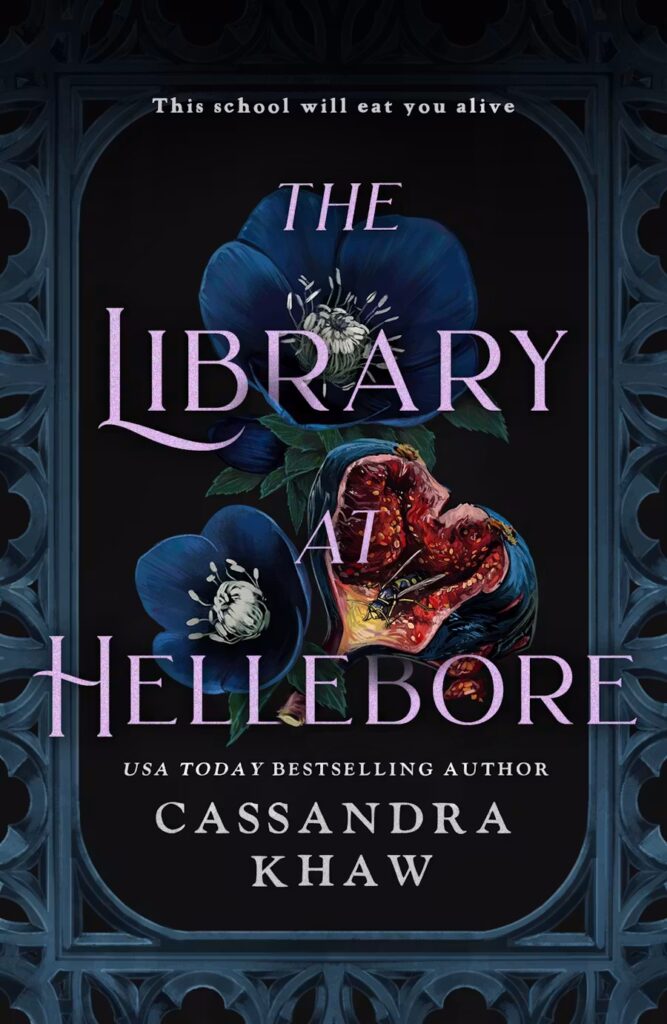
What can you tell us about your latest book, The Library at Hellebore? What was the inspiration for this story?
I’ve been describing it as a mix of Battle Royale meets The Magicians with enough gore to make the boys in The Boys blush. It’s the story about a girl named Alessa Li who finds herself kidnapped to the Hellebore Technical Institute for the Gifted, where all the Antichrists and Ragnaroks incarnate find themselves. Here, they have a shot of being more than world-ending horrors. Here, they could learn how to become something loveable instead.
Except of course it all goes wrong.
The inspiration for the book is an odd one, I guess. I think a lot of us grow up being told that there’s a path to follow if you want to be safe and loved and successful: go to a good college, get a good job, meet someone, start a family. Except I think as I’ve gotten older, I’ve realized that a lot of unscrupulous systems exploit this belief. We end up being driven to burnout as interns; we’re told to do 80 hours a week for a maybe promotion. We study what we don’t love because maybe, just maybe, we can find happiness after that. Through suffering first. Always, we need to suffer to be loved. But more often than not, these are just hollow promises, ways to incentivize people to allow themselves to be eaten up and swallowed by the world. The tools of power, I guess. The Library At Hellebore holds a lot of my rage at this understanding of the world, my fury at how it breaks us and turns us against one another, how we’re discarded in the end. Commodities and nothing else.
As seen in previous work like The Salt Grows Heavy and Nothing But Blackened Teeth, you appear to have a taste for folklore and fairytales when it comes to influencing your work. What draws you into these stories?
You could say it’s in my blood. I grew up in Malaysia, which is wildly multicultural and I think I was aware of half a dozen mythologies before I was even ten. When you’re surrounded by such things, it’s hard not to be influenced.
As a writer, what drew you to the art of storytelling, particularly speculative fiction?
My dad. He was a terrible, horrible abusive monster of a person–but he was also the literal sun in my universe when I was a child. God, he was a storyteller. He could spin random stories at a drop of a hat and I’d be absolutely mesmerized. As I grew older, I took on that role for my nieces and nephews and even my younger sister. So, I guess some of it is legacy: a way to connect with the part of my dad I had loved unconditionally (and maybe to the child who was innocent enough to think of him as their hero.)
The other thing I think is, well, storytelling helps me process what’s happening in the world and what’s happening in my life. It’s a story as old as time, I feel. If I don’t know how to hold a certain truth in my head, if something feels too enormous to even begin studying emotionally, I mellify it in prose and then examine it through the amber. It makes it safer, in a way, and it lets me approach those things from a perspective that isn’t entirely grounded in my anxieties.
How would you describe your writing process?
Chaotic. So. Chaotic.
What are some of your favorite elements of writing? What do you consider some of the most frustrating/challenging?
Prose. The joy of a good sentence. Lounging the words. Writing the gore. God, I really enjoy writing body horror. To a degree, honestly, that’s maybe clinically concerning.
And honestly, the most challenging elements of writing remain finishing the goddamned job.
Aside from your work, what are some things you would want others to know about you?
I am astonishingly food-motivated. I once spent forty minutes dragging myself through a blizzard because there was the promise of home-cooked food.
What’s a question you haven’t been asked yet but that you wish you were asked (as well as the answer to that question)?
No one asks me what is the hardest thing I’ve learned in pole and frankly, it’s keeping my face still when I’m in an extraordinary amount of pain. Do you know how hard it is to look serene when you’re upside down and your thigh is at risk of being degloved? Do you? DO YOU?
What advice might you have to give for any aspiring writers?
I wrote a lot of short fiction when I was starting out and I remember submitting something to a magazine once, and the editor responding with a, “I love this except I don’t buy the meta elements.” Up until that moment, my first instinct in those situations was to immediately carve out whatever the editor didn’t like so I could ‘fix’ the story before sending it to the next magazine. But that time, I didn’t. I actually believed in the story as it was and sent it to the next outlet. Very shortly after, I got an acceptance. Both of these venues were pro-level.
Does it mean the first editor was wrong? No. It just meant the story wasn’t to his specific tastes, and that’s okay. I’m sort of getting into the weeds here with that anecdote but if there was any advice I’d want to give aspiring writers, it’s this: when you’re told by someone this isn’t my thing, it isn’t necessarily because the work is bad. Oftentimes, it is exactly what they say it is, a case of mismatched tastes. As writers, we need to remember that and we need to learn to interpret such critique correctly, to know when someone is expressing they just don’t vibe with our work and when the work needs an actual overhaul.
Are there any other projects you are working on and at liberty to speak about?
I’m working on the edits of my next book right now. It’s about a woman whose family is cursed to see their impending death as a literal black dog, and it deals a lot with passive suicidal ideation, about what constitutes a good life. Old ghosts and the way we reframe their hauntings out of fear of abandonment. The strange ways that mothers and daughters are tethered. As you can see: lots of fun happy shiny stuff.
Finally, what books/authors would you recommend to the readers of Geeks OUT?
Hache Pueyo is one of my favorite recent writers. Get both her books. I adore Cameron Sullivan and his debut The Red Winter, and if you’ve not read Kathleen Jennings, you need to go read Kathleen Jennings. Now now now.
0 Comments