
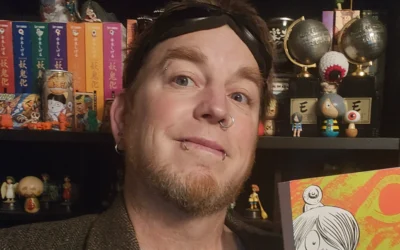
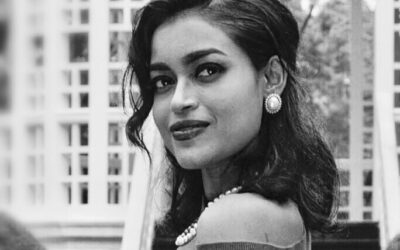
DANAI CHRISTOPOULOU is a queer Greek author who currently haunts a forest in Sweden. They’ve been a journalist, a copywriter and a ghostwriter for years before pursuing fiction. When not writing, Danai is still immersed in stories, in their capacity as an associate literary agent for The Tobias Literary Agency, and as an editor for khōréō magazine.
I had the opportunity to interview Danai, which you can read below.
First of all, welcome to Geeks OUT! Could you tell us a little about yourself?
Hi and thank you for having me! I was born and raised amid the ancient ruins of Athens, Greece, but immigrated to Scandinavia in 2017. After a brief stint in Norway (so beautiful, so cold, so expensive) I now live in a small witchy cottage in a Swedish forest together with my army of cats, chickens, the odd visiting deer and a very kind Swede. I’ve been writing in some capacity —copywriter, journalist, ghostwriter— since I was 19 years old, but I only started pursuing fiction in 2021. Vile Lady Villains is my debut novel, and I’m so thrilled to see it published in the UK from Penguin Michael Joseph, in the US from Union Square & Co, and in my homeland of Greece from Anubis Books. My hobbies include obsessing over the future of Doctor Who, bemoaning the cancellation of the Wheel of Time, and searching for the next piece of media that will alter my brain chemistry the way Tamsyn Muir’s Gideon the Ninth did.
What can you tell us about your book, Vile Lady Villains? What was the inspiration for it?
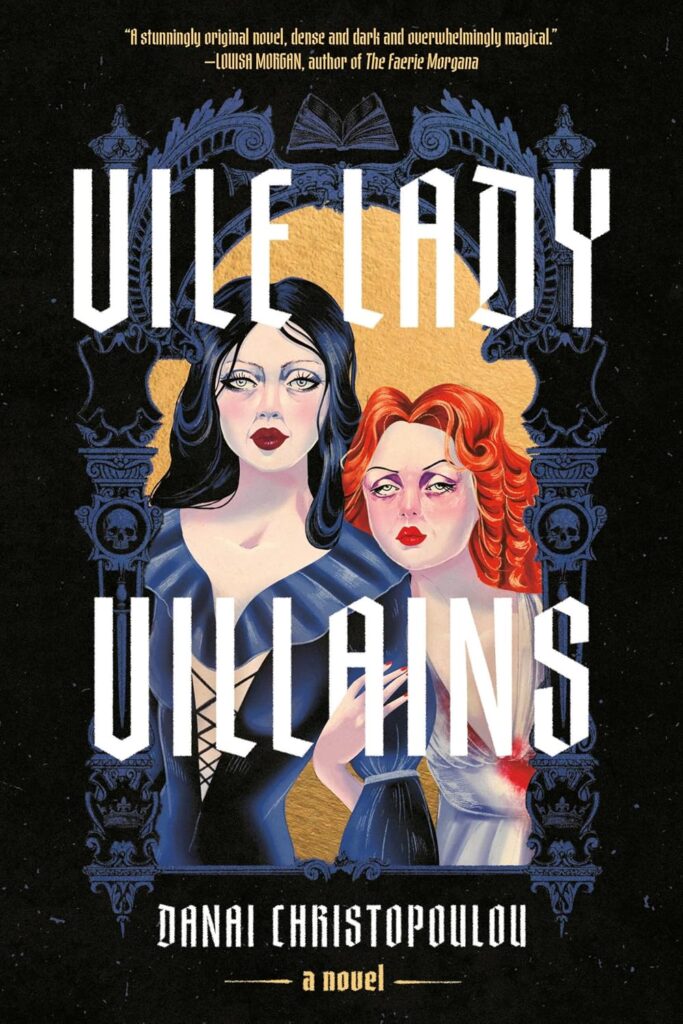
Vile Lady Villains is a sapphic horromantasy that asks a very simple question: what would happen if Klytemnestra and Lady Macbeth met in a limbo realm and they had to work together to survive? I’ve been thinking about that question since 2021, but in a more real sense since childhood. Both my parents were actors, so I grew up memorizing monologues of ancient Greek drama and Shakespeare and these characters have been living rent free in my brain since.
I always felt their journeys and the way they were depicted on the page by their (male) authors had a lot of similarities, but also left a lot of things unsaid. My purpose with Vile Lady Villains was to give these two a new playground to wreak havoc in, for better or for worse!
As a writer, what drew you to the art of storytelling, especially speculative fiction and romance?
I didn’t have any friends before my teens! Only mildly joking, but my special flavor of neurodivergence (which I now recognize was probably undiagnosed hyperlexia) meant I read a ridiculous amount of books at a ridiculously young age. I read the Odyssey when I was 7 years old, trying to compare the modern Greek text with the ancient Greek next to it, thinking I could teach myself ancient Greek that way… Sadly that didn’t quite work, but I like to believe it did give me an advantage by the time we were actually taught ancient Greek in school.
Greek mythology has always been fundamental in my life — my dad used to tell me stories from our ancient myths every night instead of fairytales. When we ran out of myths he knew, he would make up new stories on the spot, usually featuring a prominent Greek folklore figure from the Ottoman occupation era, called karagkiozis. These stories were my favorite, because we could shape them together and change the ending, almost like an improv session. In many ways, this has informed the way I approach speculative fiction. You take something that is known, something that works in a certain way, and you ask “yes, and?” “what if?”.
How would you describe your creative process?
I like to ignore an idea for as long as possible, until I absolutely cannot anymore, until it won’t leave me alone. (Yes, I also have ADHD.) Then I sit down and outline the heck out of it, because I need to know exactly what happens in the story before I can write the story. Then the nightmare begins: the actual process of writing the first draft, which I need to edit as I go otherwise my brain won’t be happy, so it’s always very slow and like pulling teeth. I sink into despair a couple of times, usually, before I realize that this is good, I need to see this through.
On the plus side, that means that editing is usually not that hard for me. I often enjoy the process of editing more, and with my debut novel it was one of my favorite parts of my publishing experience: getting to dive back into my story after my editor’s notes and coax certain elements more into the surface. I’m much faster at editing than I am at writing.
What are some of your favorite elements of writing? What do you consider some of the most frustrating and/or difficult?
I feel like we already covered the most frustrating and difficult part, ha: it’s the writing itself.
That being said, I do love it when a beautiful phrase comes together and the prose hits just right and the characters ring true to me even if they end up surprising me with their choices… There’s a liveliness and a magic in the act of writing itself that, for all my frustrations with it, I wouldn’t change it for the world.
As an author, who or what would you say are some of your greatest creative influences and/or sources of inspiration in general?
First and foremost, Sir Terry Pratchett. His work has taught me so much about the importance of being a little silly with your worldbuilding while also being profoundly serious about the things you have to say about the world. I also love authors like Douglas Adams and Jasper Fforde for their ability to pull off surreal themes with earnest conviction and just being so funny while at it. Clive Barker, for his ability to conjure up the most grotesque realms without losing the heart of it all. In more recent names, V. E. Schwab and Alexis Hall are my “I will read anything they write” favorite authors, both for the confident prose and for the way their stories contain multitudes.
Greek mythology might be my most obvious source of inspiration, but I am fascinated by mythology and folklore in general, as well as by theater plays. I’m also forever in awe of the core question being explored in Doctor Who: what does it mean to live forever and be a kind person, and what kind of constant transformation you need to endure for that to happen.
(If any powers that be are listening, please let me write Doctor Who IP one day.)
Aside from your work, what are some things you would want readers to know about you?
I’m a huge geek! Talk to me about comic books, cartoons, superheroes and shows like Battlestar Galactica and Buffy the Vampire Slayer (and, in case it wasn’t clear already, Doctor Who) and I will happily yap for hours. I’ve also read all 14 books of The Wheel of Time (apart from New Spring) and I only regret reading like 7 of them.
What advice might you have to give for aspiring storytellers out there?
Be very sure you want to do this. Which might not sound very encouraging at first glance, but I really want people to know that this is a very tough industry — almost as competitive as acting or singing or other performing arts. It’s also an industry that lacks meritocracy and has higher barriers of entry for BIPOC, queer and other marginalized authors, as well as for authors who come from working class environments. While luck certainly plays a big part in all this, and you might truly be the next unicorn that succeeds immediately (and I wish that for you!), in most cases it will take so much work, and so much questioning your sanity and life choices.
So you really need to be sure you want this. You really need to be willing to push through the rejections, the long waiting periods, the financial uncertainty. It’s often not fun. But it’s worth it, for me at least, and you need to be sure it’s worth it for you.
Are there any other projects you are working on and at liberty to speak about?
I’m currently in a strange kind of limbo where I’m waiting to hear back from my publisher about my option book. I really hope that one gets published one day, because it has even more sapphics, it’s even more Greek, even more bloody, even more weird.
Finally, what books/authors would you recommend to the readers of GeeksOUT?
2026 has been an amazing year for debuts and so far I’ve loved Annie Summerlee’s The Book of Blood and Roses (lesbian vampires for the win!) and Petra Lord’s Queen of Faces (trans fantasy with amazing worldbuilding!). I’m also super excited for Camille Chong’s Love, Gods & Sinners that comes out in June, and for Rachel Kitch’s The Forest Bleeds that comes out in October.
0 Comments