

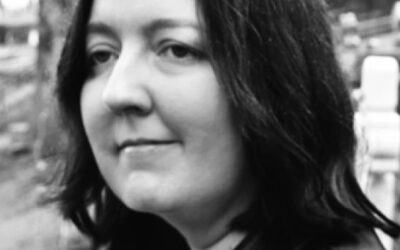
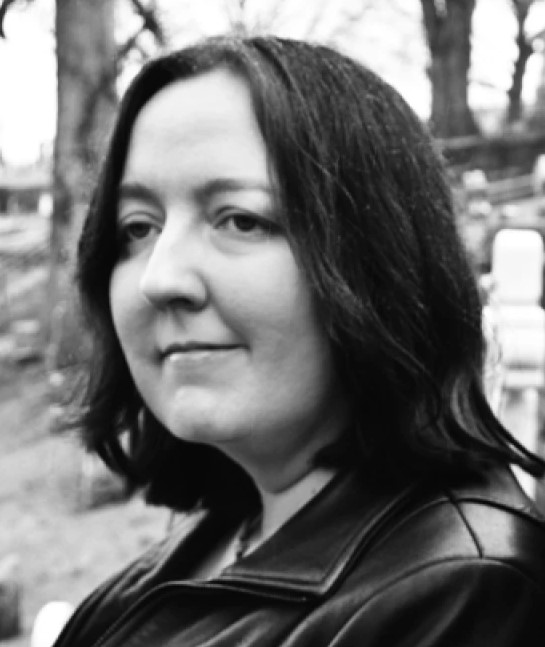
Eliza Chan is a Scottish-born speculative fiction author who writes about East Asian mythology, British folklore and reclaiming the dragon lady. Her debut fantasy novel FATHOMFOLK, published in 2024, was an instant Sunday Times bestseller. Her short fiction has featured in various magazines and anthologies including The Secret Romantic’s Book of Magic and The Best of British Fantasy.
I had the opportunity to interview Eliza, which you can read below.
First of all, welcome to Geeks OUT! Could you tell us a little about yourself?
EC: Thanks for inviting me on! I’m Eliza Chan, a Scottish-born Chinese-diaspora fantasy author who erroneously decided early on, I would follow that tried and tested route of having a dozen jobs behind me before I would write a book. I’ve worked in a bakery, a kilt shop, several call centres, as a receptionist, an English teacher and speech and language therapist. My debut novel Fathomfolk was a No 1 Sunday Times bestseller and I mostly write about East Asian mythology, British folklore and reclaiming the dragon lady. My next book, Harbour of Hungry Ghosts is out 28th July!
What can you tell us about your book, Harbour of Hungry Ghosts? What was the inspiration for it?
EC: I cheekily call this Babel meets Buffy the Vampire Slayer. It’s a historical fantasy set in mid- 19th Century Hong Kong, when the British colony was first founded. It follows a rookie monster hunter who has to prove herself after her grandmother goes missing, but is flummoxed by all the foreign monsters that keep appearing.
It’s an ode to the female action heroes of my teenage years like Buffy and Xena, but also to the old martial arts films of Hong Kong such as Drunken Master and Once Upon a Time in China. I basically wrote an action-packed romp.
As a writer, what drew you to the art of storytelling, especially speculative fiction?
EC: I remember feeling bereft as a young reader, when the story ended and I had to put the book down. I desperately wanted to go on these adventures and live in these wonderfully magical worlds (that were so much more interesting than my own life, of course) so decided to take matters into my own hands. As I’ve grown, I’ve also come to appreciate how speculative fiction can take real world issues and make us think about them in a new light. Fathomfolk looks at race and prejudice in a multicultural city but its humans versus sea folk. Harbour of Hungry Ghosts considers colonialism under the guises of foreign monsters.
How would you describe your creative process?
EC: Fraught?! I’m not the writer with a hundred new ideas from the get-go. I tend to write and get stuck and write a bit more. Drag myself through and wonder if I was kidding myself. Honestly I think sheer stubbornness is the main reason I don’t give up. At some point everything coalesces, but usually this is when I get to the end of a first draft. As much as I do plan, make a detailed synopsis and do all the research, a lot of the magic only happens during writing. It’s frustrating as it would be a lot more useful if the ideas came earlier, but I’ve just had to accept that’s the way my creative brain works.
What are some of your favorite elements of writing? What do you consider some of the most frustrating and/or difficult?
EC: I have been surprised to discover I really enjoy the research aspect of writing. I am not someone who reads non-fiction by in large, but when I have a reason to do so, I find myself really enjoying books about niche history or science. Doing the research before writing is quite a magical phase as all the ideas are whizzing around and everything looks shiny and perfect in my mind before I try to transfer it onto the page!
The most difficult element about writing is not the writing for me, but the comparison game that comes with being an author. There’s always someone who is writing faster, getting a bigger deal or more promo and that comparison is most definitely the thief of joy.

As an author, who or what would you say are some of your greatest creative influences and/or sources of inspiration in general?
EC: In the last ten years, it’s definitely been authors who have opened doors and shown publishing and readers there’s more to science fiction and fantasy than Eurocentric straight white male protagonists. Reading short stories and novels by authors such as Fonda Lee, NK Jemisin, Zen Cho and Tasha Suri has given me permission to be bolder with the stories I write and not worry so much about it fitting market trends.
I also love that we are more open and honest also about inspirations outside of books these days such as computer games, anime, film and TV. It used to be embarrassing to admit I still watch animation (at your age?) but now I’m proud to call myself an Arcane, Avatar: the Last Airbender and Fullmetal Alchemist: Brotherhood fan.
Aside from your work, what are some things you would want readers to know about you?
EC: One of my favourite indulgent activities is going to a workshop to learn a traditional art or craft. To date I’ve tried blacksmithing, glassblowing, longbow making, jewellery making and spoon carving. It has given me so much respect for these artisans, often whom are losing their jobs to mass produced and cheaper equivalents. I also love to hear about how they ended up in such interesting professions and the passion that drives them.
What’s a question you haven’t been asked yet but that you wish you were asked (as well as the answer to that question)?
EC: What’s my favourite Cantonese idiom from the book? (Which yeah, I guess since most people haven’t read it yet, is a bit of a moot point…)
The answer is tricking a ghost into eat tofu which is like saying liar, liar pants on fire to denote suspicions of lying/cheating. It’s something my mum says so I’ve heard it growing up, but never thought to question it before. Why are you tricking a ghost? Why tofu? Because it’s white? Bland? Why?! Turns out there’s an old story that a hungry ghost was about to eat a scholar but he managed to convince the ghost he wasn’t very tasty and the tofu would be better. A smooth liar indeed.
What advice might you have to give for aspiring storytellers out there?
EC: There are no rules, only guidelines. Some people do creative writing courses, or write at 5am, on their lunch break, or only on every other Tuesday. Some people set themselves word count targets, or count the hours at their computer. They write at home or in coffee shops, alone or with friends. Try everything once, but only keep up with the things that are useful to you. Discard the rest. Don’t worry about what bestseller so-and-so does, their brain is not your brain. Their life and commitments and energy levels are not yours. As long as you keep writing, a word, a paragraph, a chapter, a book—you’ll get there at the end.
Oh and find your people. Writing is incredibly lonely at times. It’s wonderful to find people to celebrate and commiserate together, to be crit partners and just to understand this weird compulsive part of our brains that cannot stop writing even if we wanted to.
Are there any other projects you are working on and at liberty to speak about?
EC: I’m currently drafting the sequel to Harbour of Hungry Ghosts, which is set in Victorian era London. I’ve also written a picture book which is out in August about the Chinese moon goddess Chang’e (Little Myths series). Beyond that I have a few ideas but still at the tinkering phase.
Finally, what books/authors would you recommend to the readers of GeeksOUT?
EC: So many, but I’ll pick a few that come to mind!
City of Others by Jared Poon is an urban fantasy set in Singapore with the deeply exasperated voice of anyone who has had to deal with bureaucracy and red tape. It opens with undead ducklings, need I say anything else?
Anything by Amal El-Mohtar but most recently I read her collection Seasons of Glass and Iron which reminded me of how wonderfully emotive short fiction can be. I cried at least three times, be warned!
And The Water Outlaws by SL Huang, which I feel flew under the radar somewhat, but is a masterful retelling of The Water Margin but with a gender-flipped, feminist agenda. Um, yes, yes please. Fans of Shelley Parker-Chan, you need to read this one.
Header Photo Credit Sandi Hodkinson


0 Comments