
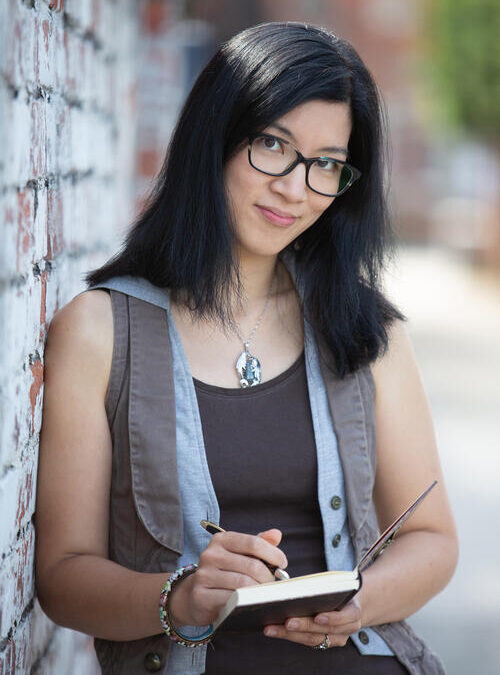
Shelly Jay Shore is a writer, digital strategist, and nonprofit fundraiser. She writes for anxious queer millennials, sufferers of Eldest Daughter Syndrome, recovering summer camp counselors, and anyone struggling with the enormity of being a person trying to make the world kinder, softer, and more tender. Her debut novel, Rules for Ghosting, was a national bestseller and was named one of the New York Times Book Review’s Best Romances of the Year.
I had the opportunity to interview Shelly, which you can read below.
First of all, welcome to Geeks OUT! Could you tell us a little about yourself?
Thank you for having me! I’m a queer Jewish author living in Western Massachusetts, on the ancestral lands of the Stockbridge-Munsee Community Band of Mohicans. My original professional background is in social work, and I spent a few years doing clinical work with children and adolescents before I pivoted to the communications side of the nonprofit world. Now I split my time between writing, editing, and nonprofit consulting. When I’m not doing any of that, I’m reading, doing yoga, or hanging out with my furry and non-furry children.
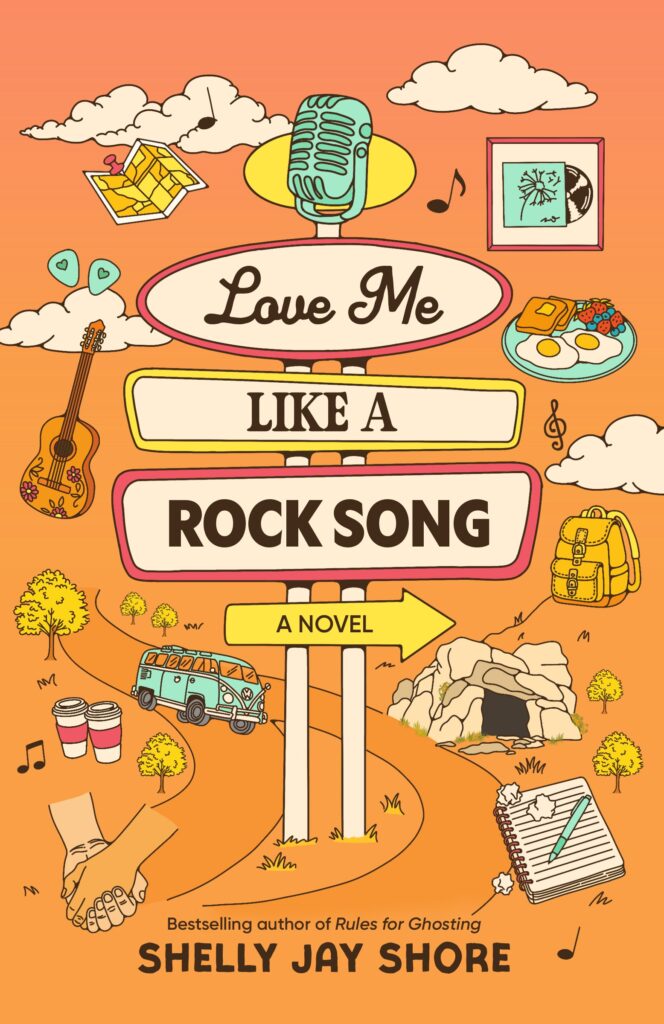
What can you tell us about your latest book, Love Me Like a Rock Song? What was the inspiration for it?
Love Me Like A Rock Song is a road trip rom-com about Delilah, a singer-songwriter who was just left at the altar and decides to turn her honeymoon road trip into a spite-songwriting road trip. On her way from New York to California, she meets Emmett, who turns out to be a golem – a being from Jewish folklore formed out of clay. Emmett is heading in Delilah’s direction, and they end up traveling together. Romance ensues!
I’ve always been fascinated by the golem myth, and the many many ways it’s been interpreted by writers over the years. I was inspired by books like The Golem and the Jinni by Helene Wecker, which is one of my favorite takes on the golem as a being that’s deeply connected to humanity but can never quite experience humanity for themself. I’m also a huge fan of road trip stories, especially queer ones – I think the earliest way I described this book was “The Golem of Prague meets The Adventures of Priscilla, Queen of the Desert meets Almost Famous,” and weirdly, that’s still kind of the core of the story.
As a writer, what drew you to the art of storytelling, especially speculative fiction?
I’m obsessed with storytelling, not just as an art but as a form of connection that goes all the way back to the very first groups of humans. The neuroscience of storytelling, both telling and experiencing stories, is fascinating – learning about that has been transformative to the way I write, to the point that I actually teach workshops on it to other writers. Stories create shared experiences, encourage us to think and feel and imagine and grow. Writing is the way I’ve chosen to practice storytelling, but I personally think stories can be told in so many ways.
Speculative fiction is sort of a natural extension of that. There’s a great quote from writer and activist adrienne maree brown: “Science fiction is simply a way to practice the future together.” I think speculative fiction does the same thing – it requires a certain amount of curiosity, a willingness to poke at parts of the world that seem unshakeable and then wonder about what it might be like to shake them up and imagine something new and different.
…It’s possible that being introduced to Star Trek at an extremely young age was something of a formative experience.
As a queer and Jewish reader, myself, I love seeing more books that cover this intersection. What does it mean to you as a queer and Jewish writer to write such representation into your work?
I’ve always experienced my queerness and Jewishness as fundamentally linked, in terms of what I value and what I look for in community and the way I move through the world. I never really had to question whether I would write queer books or Jewish books; it was always going to be a combination.
Something that felt extremely important in my first novel, Rules for Ghosting, and equally important in Love Me Like A Rock Song was an understanding that queerness and Jewishness can coexist, and don’t have to be in conflict. The characters in these books, like so many queer Jewish folks I know, are perfectly content and comfortable in holding those identities together. The characters are influenced by those identities, the story is influenced by the way those identities influence the characters, but they’re just another aspect of who those characters are.
This isn’t to say that the representation isn’t important – it absolutely is! – but to me it was just as important to write about Delilah being fat and dealing with mental illness as it was to write about her being bisexual and Jewish. That being said, it’s been really meaningful to hear from people who are seeing that intersection and feeling seen in a new way.
How would you describe your creative process?
Oh, she’s a mess! I spend the beginning of any new project doing a ton of what I would call vibes-based work – mood boards, playlists, aesthetics, sensory notes (what the story should look like, feel like, smell like, taste like, sound like), really messy plot and character maps. Then I usually have to sit with that for a few weeks before I can start finding the gems in that metaphorical pile of rocks, in order to start crafting them into something worth reading.
What are some of your favorite elements of writing? What do you consider some of the most frustrating and/or difficult?
I actually really love the revision process, which I know a lot of people can’t stand. Doing a reverse outline – basically going chapter by chapter and noting the way the key story elements have actually played out in the draft rather than what I imagined them doing in my head. From there I start picking out problems and turning them into a color-coded to-do list, which is basically my favorite thing in the world.
I’m not one of those writers who has a million book ideas floating around my head at once, so for me one of the most frustrating aspects of my process being patient enough to find the right spark of inspiration. It always shows up eventually, but boy is it slow.
As an author, who or what would you say are some of your greatest creative influences and/or sources of inspiration in general?
I’ve definitely been influenced and inspired by Jewish folklore and mythology, which I first started getting into in college, as well as sort of “old-school” queer fantasy: the Nightrunner books by Lynn Flewelling, Swordspoint by Ellen Kushner, just about anything by Jacqueline Carey. These days I take a lot of inspiration from queer retellings of myths, fairy tales, and other classics, and works that play around with genre-mixing, fun takes on craft and style and voice – works that are creative in unexpected ways.
Aside from your work, what are some things you would want readers to know about you?
I am 100% a Little Treat Girlie (gender neutral). I’m basically incapable of walking past a bakery without poking my head in to see if I can acquire some kind of pastry.
What’s a question you haven’t been asked yet but that you wish you were asked (as well as the answer to that question)?
What is your biggest literary crime?
I stole a copy of Spindle’s End by Robin McKinley from my middle school library because I loved it so much I didn’t want to give it back. I still have that copy. (I did send them a new one!)
What advice might you have to give for aspiring storytellers out there?
Find a creative community where you feel safe, and start building those connections. It’s so easy to see other creatives as competition and to constantly be comparing yourself to others, but those people are your people.
Are there any other projects you are working on and at liberty to speak about?
Still very much in the planning stage, but my next book straddles the line between gothic romance and horror romance, set at a fictional school of Jewish mysticism. It’s still queer and Jewish and speculative/paranormal, but much darker than either of my first books.
Finally, what books/authors would you recommend to the readers of GeeksOUT?
I’m going to cry if I have to make choices, so I’m going with books I can see from where I’m sitting at my desk:
The Left Hand of Darkness by Ursula K. Le Guin
Cursebreakers by Madeleine Nakamura
The entire Inheritance series by A.K. Faulkner
This is How You Lose the Time War by Max Gladstone and Amal El-Mohtar (and The River Has Roots by Amal El-Mohtar, especially the audiobook!)
Mistress of Lies and Lord of Ruin by K.M. Emright (warning, these are the first two in a trilogy!)
The Gardener’s Vine series by Felicia Davin
Header Photo Credit @MerQueenJude
0 Comments