
Zack Davisson is an award winning translator, writer, lecturer, and scholar of manga and Japanese folklore and ghosts. He is the author of YUREI: THE JAPANESE GHOST, YOKAI STORIES, and THE SUPERNATURAL CATS OF JAPAN from Chin Music Press.
I had the opportunity to interview Zack, which you can read below.
First of all, welcome to Geeks OUT! Could you tell us a little about yourself?
Thanks for having me! I’m Zack Davisson, professional geek. I tend to dabble in a lot of things, many fingers in many pies. I’ve written for Marvel comics, for Lucasfilm… I’ve translated series like Devilman, Record of Lodoss War, and Space Battleship Yamato. I also do academic work, lecturing for museums and colleges. I’ve taught at Duke University, at the Art Gallery of New South Wales, at the Universita Ca’ Foscari Venezia. I taught a class at Annapolis Naval Academy, which still cracks me up. As a former punk rocker and general ne’er-do-well, no one imagined I would grow up this respectable.
In my personal life, I’m a saber fencer, have way too many Warhammer figures waiting to be painted, way too many Magic cards waiting to be put into decks, play old-school RPGs with my pals every Wednesday, drink fancy whisky and barrel-aged beer, and spend all my extra time and money on traveling. Oh, and I have the cutest dog, cat, and fish in the world. Mochi, Shere Khan, and Deme King. I don’t have an Instagram, but my dog does. (mochidogofadventure).
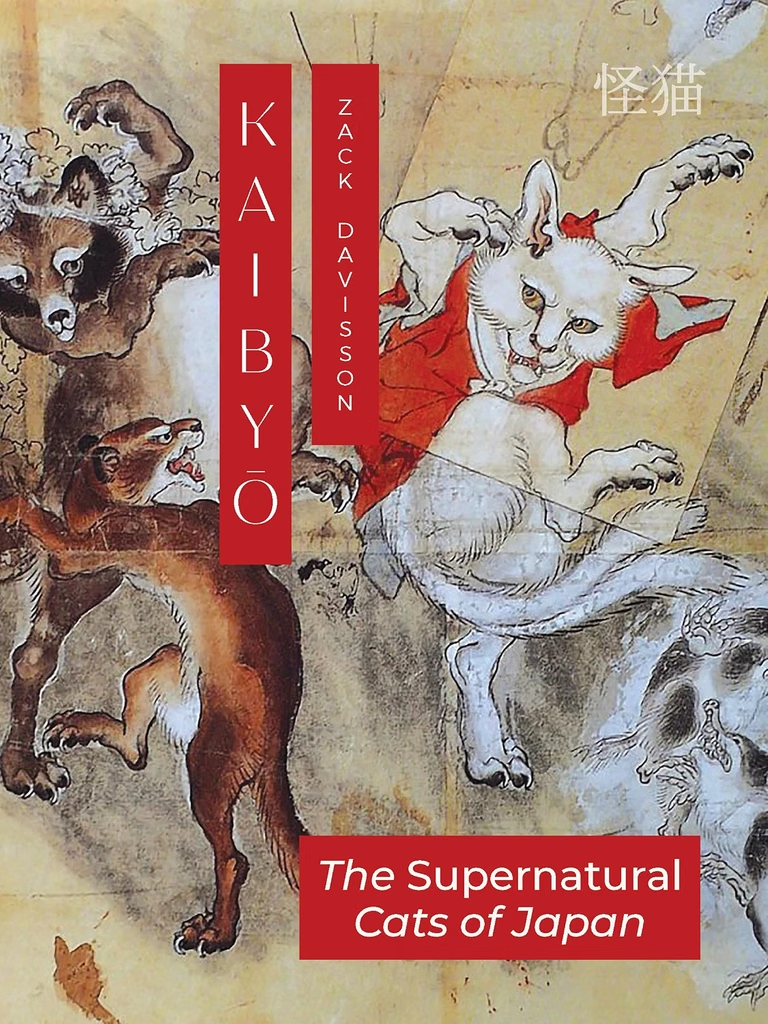
What can you tell us about your latest book, Kaibyo: the Supernatural Cats of Japan? What inspired this project?
Kaibyo came directly out of a comic Wayward I was working on for Image comics. One of the main characters, Ayane, was a neko musume—a cat daughter. I did a bunch of research for her and fell down the rabbit hole of Japanese magic cats. I got curious about this history of cats in Japan and their folklore and history. It was my book designer who realized I had amassed enough material for a book.
Kaibyo: the Supernatural Cats of Japan is my most popular book, but one I never intended to write. It’s like the cats got their claws in me and never let go.
What inspired you to get into writing? Were there any favorite writers or stories that sparked your own love and interest in storytelling?
I think like many it was always just a natural part of my life. I’m a voracious reader who has lived inside of books all my life. Robert E. Howard. David Eddings. Larry Niven. Lovecraft. Tolkien. And comics, sooo many comics.
Writing has always come naturally to me, even though it wasn’t my passion. Originally I wanted to be a comic artist. I went to art school with that goal but realized that I didn’t have what it takes. I was mediocre at best, and there is no room for mediocre comic artists when there are so many amazing ones. With being an artist off the table, I looked at what else I could do to still be in the game. So, I explored my strengths and started writing. And it turns out I was good at that.
Fortunately, readers have thought so too!
As a translator, researcher, and writer, what sparked your interest in Japanese culture?
There is a specific moment; when I was eight my mother took me to see Seven Samurai and my world changed. It was the first time I spent immersed in a foreign language and I was fascinated. I wondered how that gibberish could have actual meaning, and what it must like to be inside their heads. I guess I imprinted on it then and there.
There were other things as well, watching Star Blazers growing up, and Chris Claremont’s Japan adventures in the X-Men… if you look back at pictures of me as a kid in the 80s I was always wearing some sort of Japan-themed t-shirt.
Then when I was in my 30s I finally decided to follow my bliss and go there. I was working at Amazon at the time as a project manager. I applied to the JET program, quit my job, and never looked back. And that has made the difference ever since, as the poem goes.
How would you describe your creative process?
Someone described it once as pouring all the Legos out of the box and then putting them back together again in some sort of shape. I thought that was pretty accurate. My pal Jim Zub says with writers there are plotters and pantsers. Plotters work out their entire outline first and then start filling it in; pantsers fly by the seat of their pants. They start typing and see what happens. That is definitely me.
I’m mostly a creature of the id. I never know what is going to happen in a book until it happens.
What are some of your favorite elements of writing/ research? What are some of the most challenging?
My favorite part is taking a long-accepted truth then chasing it down to find out that it is false. There have been “facts” I’ve repeated for years and later found to be entirely untrue. That is a delight to me. I love how human experience shapes stories, and how we need “truths” even when they are not true. Every civilization has venerated forgeries. That delights me.
Most challenging is hunting things to the original source. You have to dig and dig an dig an keep digging, and sometimes make peace with the fact that the origins are lost to time.
What’s a question you haven’t been asked yet but wish you were asked (as well as the answer to that question)?
No one has ever asked me “What’s the difference between writing and translating?”
The answer is… not as much as you would think. Both are creative, intuitive processes. The biggest difference is that with translating I am finding someone else’s voice. I need to hear them in my head in order to properly write them in English. But when creating new work, I also search for a voice. Something inside my head that I listen to and then connect to my fingers to type out. It’s all a process of taking in outside influences, internalizing them, then putting them back out in a way that is hopefully engaging.
What advice might you have to give for aspiring writers?
The only advice any writer needs—write. No one needs to give you permission. There is no Grand Council of Writers who bequeath a title upon you. And the only excuses you have are the ones you give yourself. I wrote my first book the bus commuting to work. I’d grab a seat, plop open my laptop, and write until my stop. Rinse and repeat for two years and you come out with a book at the end.
Besides your work, what are some things you would want readers to know about you?
I think the breadth of my work can be confusing to readers. We like our creative talent to be one thing. If you’re a drummer, you’re a drummer. If you play bass, you play bass. But I dabble in several things. And I love them all.
Oh! And being a professional geek doesn’t make you less of a geek. Some fans have the opinion that once you start getting paid for something you can no longer be a fan. I assure you this is not true. I am so much of a fan I decided I needed to make this my entire life.
Finally, what books/authors would you recommend to the readers of Geeks OUT?
Lafcadio Hearn is probably my biggest inspiration for my career and who I recommend. I tend to like older works. I’m currently reading Sheridan Le Fanu’s Uncle Silas. Before that I read Ira Levin’s Rosemary’s Baby. And Chuya Koyama’s comic Space Brothers. That is brilliant.
And I highly recommend the complete works of Zack Davisson. Buy them all, and copies for all your friends and family too. I need some new Warhammer figs.
0 Comments