
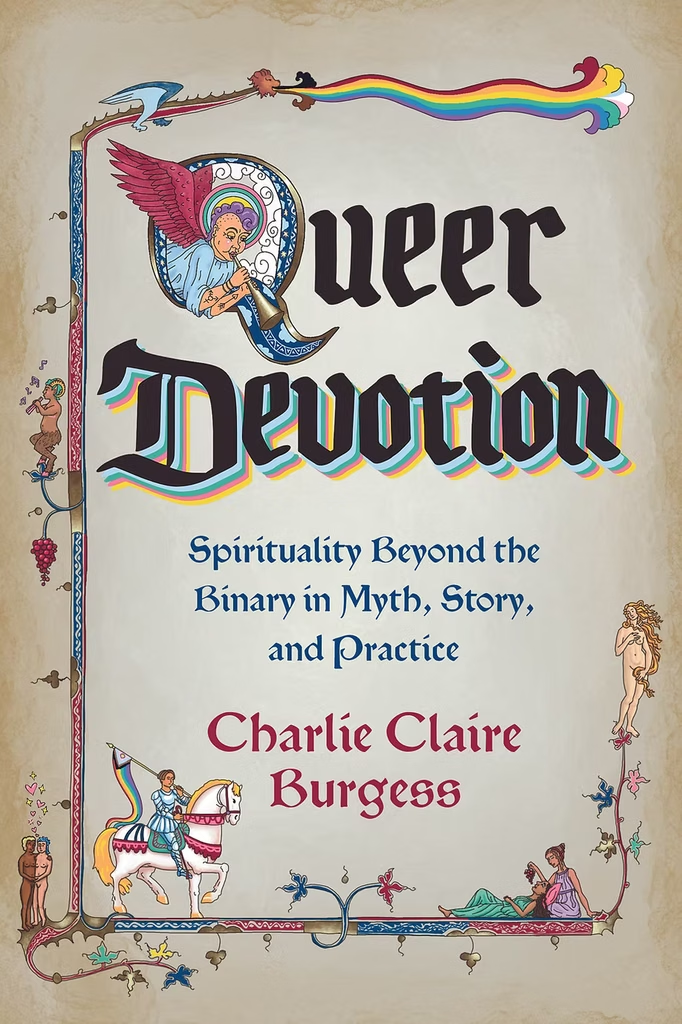
Charlie Claire Burgess (they/them) is a queer and trans-nonbinary author and artist working at the intersection of spirituality and queerness. They are the author of Queer Devotion and Radical Tarot and the creator of Fifth Spirit Tarot and The Gay Marseille Tarot. Their nonfiction writing has appeared in The Lambda Literary Review, The Rebis, F(r)iction Magazine, and the Tarot in Other Words anthology, and their short stories have received a Pushcart Prize Special Mention and notable mentions in two Best American anthologies.
I had the opportunity to interview Charlie, which you can read below.
First of all, welcome to Geeks OUT! Could you tell us a little about yourself?
Hi! I’m Charlie, pronouns they/them, and I’m a queer and trans nonbinary author, artist, and tarot deck creator. All of my projects have queerness at heart, and I mean queerness not only as an identity but as an ethos, a way of engaging with the world from a marginal orientation that troubles the status quo and prioritizes curiosity, questioning, and emergence. I’m a nerd for history and mythology, and I adore fantasy and horror. I’m a tarot reader and teacher, a student astrologer and herbalist, and the parent of a one-eyed pug named Apollo. The astrologically inclined will be unsurprised that I’m an Aquarius sun, Gemini moon, Scorpio rising.
What can you tell us about your most recent project, Queer Devotion Spirituality Beyond the Binary in Myth, Story, and Practice? What was the inspiration for this book?
Far more often than not, LGBTQIA+ people are left out of history and religion. We’re told that we’re a new fad or, worse, an evil abomination. Mainstream religions either include us as an afterthought or kick us out of the sanctuary altogether. As a queer and trans person raised in the Bible Belt, I know first-hand how deeply harmful such messaging is. And as a lifelong mythology nerd, I also knew from a young age that none of it is true! Even so, that homophobic and transphobic conditioning still seeped in and prevented me from embracing my queerness and transness until age 30. It also deprived me of spiritual connection.
Queer Devotion grew out of my own decade-long search for queer spirituality. The book explores queer divine figures in mythology, religion, history, and folklore, because we’ve always been here, and we’ve always been part of the sacred story. One of the major motivations for the book was to fight against the erasure of LGBTQIA+ history that the ruling class is actively waging against us and has been for 2,000 years. I wanted to highlight the stories of actual queer and trans people—like the transfeminine gala and galli that served as priestesses of Inanna/Ishtar and Kybele, or like cross-dressing and gender-nonconforming Catholic saint, Joan of Arc—and I wanted to illuminate queer themes and resonances in sacred stories, from transgender Aphrodite, to genderqueer Odin, to homoerotic Sir Gawain and the Green Knight.
Queer Devotion is also, well, devotional. I include contemplation questions, exercises, and rituals to help other LGBTQIA+ folks connect with the queer divine of their understanding. Because cultivating a queer spirituality—a devotional queerness—can be deeply healing and affirming, and it can also foster a great deal of strength and resilience. And we need that right now. In a world that predicates so much of its hatred and persecution of trans and queer folks on supposed religious excuses, queer spirituality is inherently liberatory and revolutionary.
Are there any titles you feel stand in conversation with Queer Devotion?
Absolutely yes! Queer Devotion probably wouldn’t exist without Ariana Serpentine’s Sacred Gender and Misha Magdalene’s Outside the Charmed Circle, both of which were so important on my own queer spiritual path, and which I consider to be my book’s direct ancestors. Reading our three books together would make a great queer witchy book club! Just saying! Two other books that recently came out and would be great companions to Queer Devotion are Sacha Coward’s delightful Queer As Folklore and Enfys J. Book’s Queer Rites. Queer Devotion also stands in the shadow of Sophie Strand’s The Flowering Wand, which retells myths of the sacred masculine in such an unconventional and organic way that it inspired me to be weirder, go harder, and not hold back.
As a writer, what drew you to the art of storytelling?
Stories are everything! Stories are how we make meaning of the world, how we understand ourselves and others, how we organize and remember our lives. To some extent, reality is just a mutually agreed upon story. History is a story that only tells one side. Politics is a story best shelved under Fiction. Myth is a story that aspires to reflect the divine. Few things are more powerful than a good story. Unfortunately, story is too often hijacked by the powerful to quash dissent, reinforce social codes, and control the people by controlling the narrative. Stories tell us what’s possible. I want to tell stories that help people get free.
How would you describe your creative process?
My creative process is 3 parts trust, 2 parts chaos, and 1 part superhuman overfocus ability. I tried for a long time to be one of those people who could just sit down and create on a schedule, but I am emphatically notone of those people. For me, it works or it doesn’t, and there’s no forcing it. So my creative process involves a lot of waiting for inspiration to strike while I’m researching, learning, teaching, reading good books, and going about the regular business of living. That’s the trust part. When I feel creatively dead, I just wait and trust that the next project, the next card, the next page will come. And it always does.
When it does, I clear my schedule, cancel plans, and create until I run out of juice. This is the chaos part: a mad spree of explosive writing or illustrating, accompanied by drifts of papers and teetering piles of research books on all surfaces. I try to take a curious and experimental approach to drafting, one that prioritizes pursuing ideas and seeing where they go, rather than sticking to a hard outline. This is also where the superhuman overfocus part comes in. When I’m in the zone, it’s common for me to write or illustrate for 12 hours a day, for weeks at a time. It’s like a trance, or like possession. I finish the project and then crash for three months until the next project stirs. It’s certainly a process of extremes, but after a decade of fighting against it, I’ve accepted that this is just how I work. And it works!
What are some of your favorite elements of writing? What do you consider some of the most frustrating and/or challenging?
I love when the writing is working. When it’s really flowing, it feels like I’m surfing a tidal wave. There’s momentum and direction, and I’m barreling toward some unknown shore on a current that’s larger than me, and I’m going to ride it till it breaks, or until I lose my balance. I love the feeling when I can finally step back and observe the writing from a distance. There’s a point when the order rises from the chaos, where I can see the design, and then I get to be clever and revise it into shape. I’ve been known to actually cackle with glee. There’s nothing better than writing and revising when it’s working!
The worst part of writing is when it’s not working, of course. But I’ve learned to not force it. Instead of banging my head against the keyboard for hours, I’m better off conserving my energy and doing something else—emails, cleaning, marketing, planning a class, or filling the creative well with a novel, a TV show, a walk in the park with a friend.
As an author, who or what would you say are some of your greatest creative influences and/or sources of inspiration in general?
Other stories. My work so far has been built on existing stories. Queer Devotion queers and retells sacred stories from myth, religion, and history. Radical Tarot reexamines the tarot system from a queer, liberatory lens. My tarot decks queer tarot imagery. The horror novel I’m working on is inspired by a certain Bible story. I’ve always been deeply interested in belief systems, the stories we tell ourselves to make sense of the world, whether those stories are spiritual, philosophical, occult, or mundane, because what we believe in reveals a whole lot about who we are. So my greatest inspiration is stories, which is to say: people.
Aside from your work, what are some things you would want readers to know about you?
I’m Southern. My partner and I are both trans and moved to Oregon a long time ago for healthcare security, but I’m Alabama born and raised. I emphasize this because, too often, coastal liberals treat the South as if it’s disposable, as if every human being that lives there is racist, transphobic, ignorant, and not worthy of saving. In reality, there are tons of trans and queer people in the South. There are tons of people of color in the South—more than in the Northeast and Pacific Northwest, that’s for sure. There are tons of artists and creatives and geniuses and huge-hearted people who deserve for the rest of the country to fight for their rights, safety, and wellbeing. People are always surprised to learn that I’m Southern. I think they see me as some anomaly or exception to the rule because the South couldn’t possibly produce a smart, creative, empathetic, queer, trans person like me! But I’m not an exception. The South is full of people like me. Fight for us.
What’s a question you haven’t been asked yet but that you wish you were asked (as well as the answer to that question)?
I’ll ask myself a question from Queer Devotion: What are you devoted to? I’m devoted to queer joy, to trans kids, and to the liberation of all people: LGBTQ+, immigrant, Palestinian, everyone. Queer liberation doesn’t exist without the mutual liberation of everyone oppressed and exploited under colonialist, capitalist empire. And the future depends on our liberation. Being devoted means being so in love with a thing that you let that love animate your actions, and there are so many ways to take action. So I’ll also ask you, reader: What are you devoted to?
What advice might you have to give for aspiring writers out there?
Don’t try to do things “the right way.” There is no right way. There’s only the way that works for you. Experiment and figure out what that is, and go from there.
Are there any other projects you are working on and at liberty to speak about?
I’ve hinted at my queer horror novel a few times, even though it’s probably too early to be talking about it. But I can’t help myself! I’m so excited. My two books so far have been nonfiction, but I actually started out writing short stories, and I’m super stoked to be returning to fiction with this project. I won’t say much, but I’ll say that it’s post-apocalyptic queer horror with Biblical themes, cults, monsters, romance, and it’s trans as hell.
Finally, what books/authors (LGBTQ+ or otherwise) would you recommend to the readers of Geeks OUT?
I just finished reading The Starving Saints by Caitlin Starling, and I am obsessed. Medieval sapphic cannibals with magic is somehow exactly my niche. I also loved Andrew Joseph White’s YA horror novels with trans/nonbinary and autistic MC’s, especially Hell Followed With Us. My standing favorite novel is the incredibly nerdy, trans, visionary Confessions of the Fox by Jordy Rosenberg. For queer, Indigenous YA about resistance fighters, I’ve been reading Tehlor Kay Mejia’s We Set the Dark on Fire duology and am in love.
0 Comments