

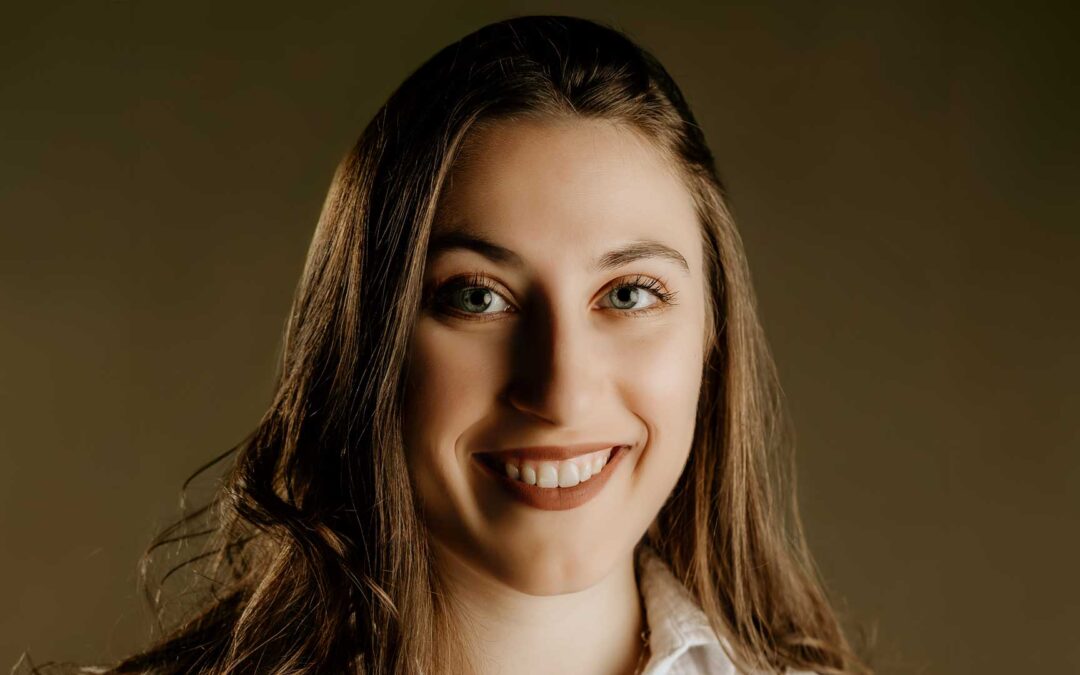
Maren Amini is a comic artist, illustrator, and cartoonist whose work lies at the intersection of journalism, literature, and organization. Humor is her primary means of communication as she feels laughter is more important today than ever. Maren lightens heavy things―through comics, cartoons, and illustration. After earning a degree in illustration and communication design, she worked freelance for publications including The Washington Post, Der Spiegel, and Die Zeit. Papa Drew a Thousand Birds, her debut graphic novel about her father’s life between Afghanistan and Germany, received the German Comic Book Prize and the Special Prize for New Talents at the German Children’s Literature Awards. Maren lives in Hamburg, Germany.
I had the opportunity to interview Maren, which you can read below.
CW: Brief mention of Taliban and assisted suicide.
First of all, welcome back to Geeks OUT! For those unfamiliar, could you tell us a little about yourself?
I am Maren Amini, and I am an illustrator, cartoonist, and comic artist.
I started drawing when I was a teenager and began making comics right away. During my studies, I drew comics at first, but then focused mainly on informative illustration.
I have worked as an illustrator all these years, doing a lot of work for magazines and corporations. I frequently draw in the fields of care guides and patient programs. I am often booked when a topic is too dry, too complicated, too sad, or too heavy to bear—that’s when I step in and try to bring a little bit of humor, light, and warmth into sterile discourses.
I always say: I make the heavy light.
Even though things aren’t exactly light right now in our current times, humor is more important than ever.
What can you tell us about your project, Papa Drew a Thousand Birds: A Memoir? What was the inspired you to make this project?
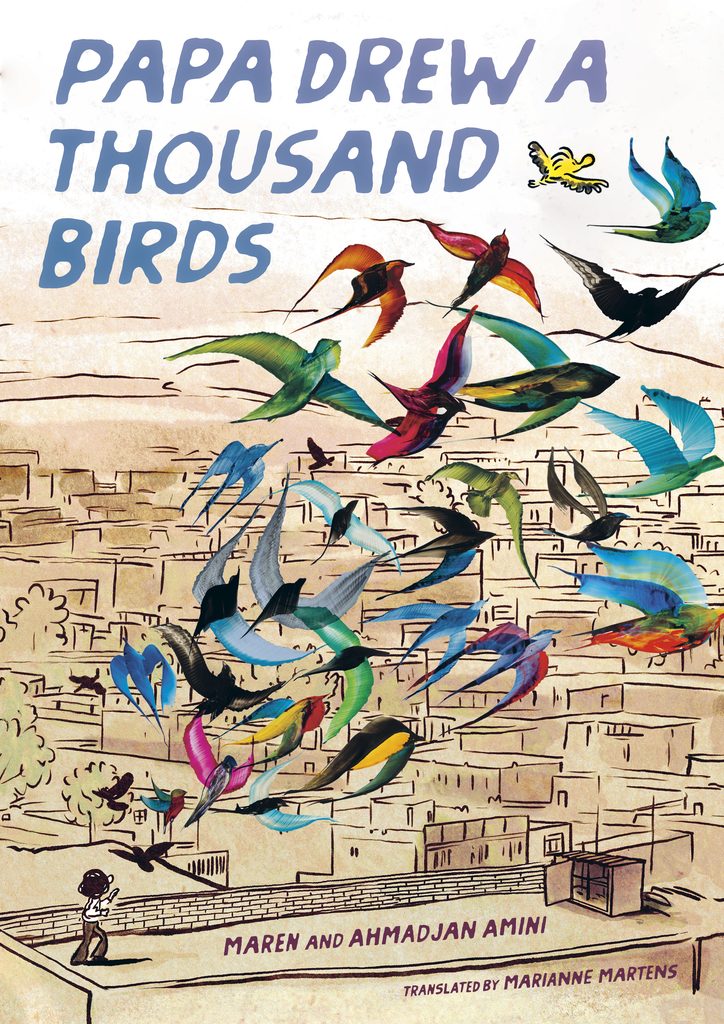
Papa Drew a Thousand Birds is a story about the life and art of my father, Ahmadjan Amini, who set out from Kabul in the early 1970s to discover the world, become an artist, and eventually landed in Hamburg, Germany. Many paths back and forth followed. I tell of this inner and outer fragmentation in the search for happiness, weaving it together with the story of The Conference of the Birds by Farid ud-Din Attar.
It all started when my dad painted 1,000 birds. And I don’t just mean roughly 1,000 birds—there were genuinely 1,000 of them. These birds deeply impressed and moved me. He painted them inspired by The Conference of the Birds by Farid ud-Din Attar, a great Persian epic and one of the most significant works of Persian literature. He created the birds using liquid acrylic with a palette knife on glossy photo paper. These birds deeply impressed and inspired me, and afterwards, I wanted to draw birds like that, too. That was the starting point for our book. . . .
For me, it was also very important to engage with my father’s artwork through the process of making this book. It serves as a beautiful symbol of my own roots.
His paintings hung and still hang everywhere—at my siblings’ homes, with friends and relatives, at his place, and at mine. They were present my entire life, but always just in the background. Especially back then, they were also very dark; as a child, I found his work terrifying, and as a teenager and young woman, I never took much special interest in them. They were simply there, and I never really paid them much attention.
Through working on the book, I looked at many of these pieces closely for the first time and learned their titles. That did something profound to me. Through that attention and the time I took to examine them closely, they suddenly became somehow much more valuable, touching, and significant to me.
As a creative, what drew you to the art of storytelling, especially graphic novels/comics?
As a child, I always loved comics: Wilhelm Busch, The Adventures of Tintin, Marsupilami, and then as a teenager, DC Comics, Spawn, and Enki Bilal.
And during my illustration studies, Marjane Satrapi’s Persepolis came out. Her work means so much to me. Her book and her story were so important to me and to so many others.
After reading Persepolis, I wanted to make comics like that. I wanted to write a comic about my father and his suffering. But a thousand things got in the way; I studied informative illustration and got more and more commissions, then came my husband, my dog, my children . . . and eventually, I stopped thinking about the idea of making my own comic altogether.
But in 2021, with the Taliban’s return to power, old wounds reopened for my father and my Afghan family, and the pain was so immense. My dad was so endlessly sad, confused, and upset that I suddenly knew the time had come for the comic I had always wanted to make. And working on it did us good; it brought us closer together, and somehow allowed us to process our pain—even though it took different forms for each of us.
Yet it still hurts, including the fact that we are doing so well here. This injustice, and the fact that it has already been five years.
Five years since art, culture, and education were banned in Afghanistan. Since life came to a standstill for so many people.
How would you describe your creative process?
I always go through the same process:
The task
The Shock
The Anger
The Despair
The Lightning
The Making
The Result
What are some of your favorite elements of writing/illustrating? What do you consider some of the most frustrating and/or difficult?
Being able to dive into another world, to daydream, to lose, disappear, and hide yourself. To forget everything around you and exist only within the story, only within the hand, within the line. The most beautiful moment is when you lose all sense of time and space in the process.
You can also put yourself in someone else’s shoes, and do so intensely.
Through this, you can come to understand things.
The frustrating part is when you can’t get in, when you’re just lingering around the edges, wanting to dive into a topic but unable to do so . . . then the work feels fake, constructed, insincere, and terribly heavy.
As a creative, who or what would you say are some of your greatest creative influences and/or sources of inspiration in general?
That’s hard to say… ideas and inspiration lurk around every corner. In the unfamiliar, in the familiar, in the newest trend and in the most ancient form.
My family inspires me a lot. I am very fortunate to have a wonderful family. But also fantastic neighbors, colleagues, and friends. They spark new ideas and lift me up.
At the same time, sad, lonely moments can be inspiring because you can daydream whole worlds into existence.
And the ancient, which is still utterly relevant today, inspires me. Just like The Conference of the Birds.
Aside from your work, what are some things you would want readers to know about you?
I love to sing and laugh. These are things I want to intentionally bring more into my life in 2026 and also in 2027. I sing a lot of karaoke and go to a lot of comedy shows.
What’s a question you haven’t been asked yet but that you wish you were asked (as well as the answer to that question)?
What’s your favorite joke:
An artist goes to the doctor, and the doctor says: ‘You only have three months to live.’
The artist replies: ‘Living on what?!’
What advice might you have to give for aspiring storytellers out there?
Never stop drawing and writing. The only thing you can do wrong is to stop. It’s good for your soul. And this is also advice for all the people who say, “I can’t draw.” If you draw a lot, you can draw. If you write a lot, you can write. It’s like that with everything in the world. It’s that simple. I think it’s important to find a way to express your feelings and get them out of your head.
Are there any other projects you are working on and at liberty to speak about?
Yes, I am currently working on an e-learning program for the German Workers’ Samaritan Federation (ASB) on the topic of assisted suicide, and on an independent project about my German family history.
Finally, what authors would you recommend to the readers of GeeksOUT?
Line Hoven, Mikael Ross, Jens Cornils, Sheree Domingo, Karolina Chyzewska, Lee Lai, Anna Haifisch, Katharina Kulenkampffs
0 Comments