
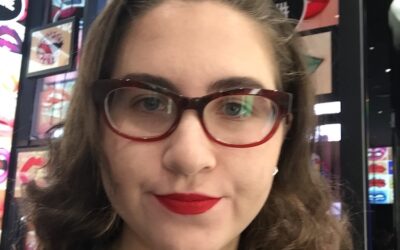
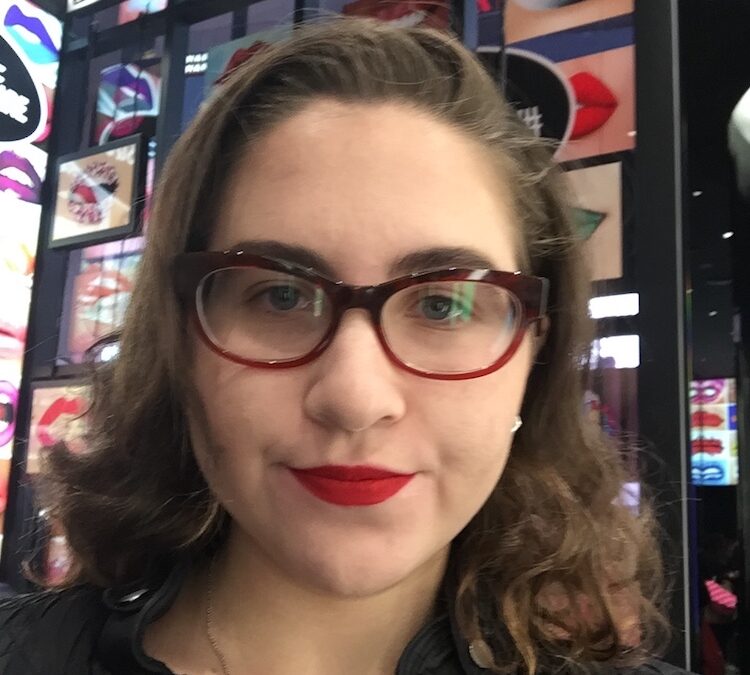
AVERY CURRAN studied history at university, where she first became interested in spiritualism. She finished an MA in Victorian Studies in 2021 and recently finished a PhD on spiritualism and queerness in the nineteenth century. She was born in New York City and currently lives in London with her girlfriend and their cat.
I had the opportunity to interview Avery, which you can read below.
First of all, welcome to Geeks OUT! Could you tell us a little about yourself?
Thank you! Very happy to be here. I’m a writer living in south-east London, with my girlfriend, who is wonderful, and our cat, who’s much more ornamental than she is useful. I finished a PhD a couple of weeks ago on queerness in nineteenth-century spiritualism, so I guess I’m also a Dr…! Spoiled Milk is my first novel.
What can you tell us about your book, Spoiled Milk? What was the inspiration for this story?
Spoiled Milk is a queer gothic horror novel about a group of schoolgirls at an isolated boarding school in 1928. After the school’s brightest star falls to her death on her eighteenth birthday, the other girls turn to spiritualism—and discover that something is very wrong at Briarley School for Girls.
I was really compelled by the idea of combining classic boarding school stories—authors like Enid Blyton, Angela Brazil and so on—with my love for horror as a genre. The isolated location is ideal for both concentrating these already complicated relationships between teenagers until they reach a fever pitch, and then introducing a supernatural element that throws everything into disarray.
As a writer, what drew you to the art of storytelling, especially gothic horror?
I have always loved horror; I think being able to scare people for money is one of the best things I can contemplate doing, and doing so via writing sounds easier than being, for example, one of the scare actors at a haunted house, who must spend so much time putting on evil clown makeup and learning to use a fake chainsaw and so on.
How would you describe your creative process?
I always find it’s difficult to describe my creative process, because I have only really worked on longform projects; this means there’s not much data to work from and small variations mean it’s hard to give a consistent answer. But thus far I’ve spent lots of time (over a year, even) letting an idea percolate before I start working on it. By the time I get started I like to have a pretty fully realised sense of what I want it to be: the characters, setting, the way I want the thematic ideas I’m working with to play out in conjunction with story. I’m a pretty ruthless outliner, though that’s mostly because I’m easily distracted and it helps me maintain pace. I do try to leave room to change my mind. One of my characters in Spoiled Milk, Evelyn, was meant to die early on, but I ended up reworking the whole thing by the time I got to the third chapter, because I was having so much fun with her. And she ended up becoming very, very important…!
What are some of your favorite elements of writing? What do you consider some of the most frustrating and/or challenging?
It’s a cliché but there’s no better experience than when you can feel it going well and everything clicks into place without even having to think about it. In general I second-guess myself a lot, so the realisation that all of a sudden I can trust my intuition wholly to take me where I need to go is hugely satisfying. If I could bottle that and sell it I’d be set for life. Conversely I once heard someone say that writing a book is like reading a book that hates you, which felt like a pretty brutal encapsulation of what it’s like when it’s not going well. The trick, I think, is in making the joins between those feelings as seamless as possible, so that easy intuitive flow is indistinguishable from a reader’s perspective from the laboured misery of chipping away at something that feels like it wants to kill you.
As authors, who or what would you say are some of your greatest creative influences and/or sources of inspiration in general?
It depends on the project, for me, but there are a few constants. For Spoiled Milk in particular, I drew on a range of influences, including David Lynch’s Twin Peaks and Fire Walk With Me; the Naughtiest Girl in School books by Enid Blyton; IT by Stephen King; Jennifer’s Body; both the book and the film of Picnic at Hanging Rock; The Time of the Ghost by Diana Wynne Jones; the Claudine books by Colette; the 1930s film Mädchen in Uniform; both versions of Suspiria. A lot of classic horror, a lot of newer queer horror; a lot of older books. I find films to be really creatively generative when writing fiction because it forces you to think about approaching imagery from a different angle—how can I evoke the feeling that such-and-such visual gives me, but in words? The answer is very rarely just describing or copying the image, because these mediums operate very differently.
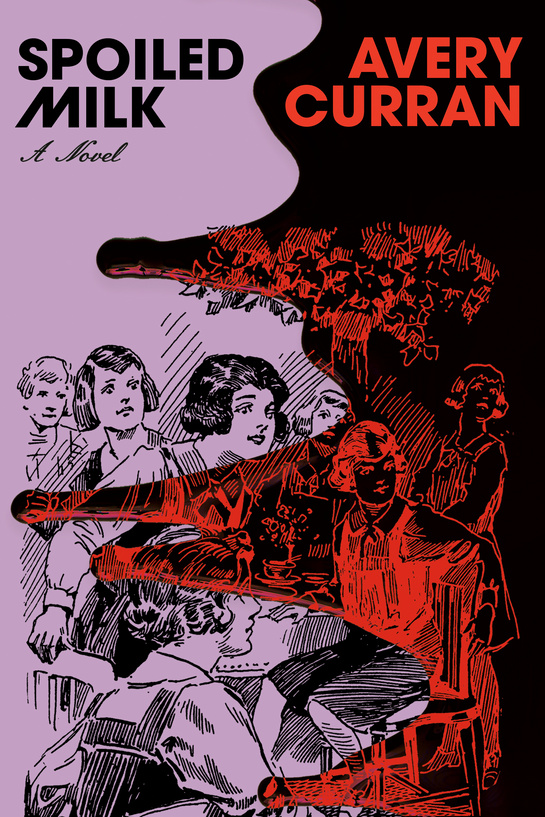
What’s a question you haven’t been asked yet but that you wish you were asked (as well as the answer to that question)?
I’d love to be asked about the novel’s place as part of a tradition of English gothic fiction dealing—however obliquely—with the colonial, from within the imperial core. When I was doing my MA, I read a fascinating book by Elaine Freedgood called The Ideas in Things: Fugitive Meaning in the Victorian Novel, which looked at these seemingly inconsequential objects and the hidden meanings they hold. There was a chapter on Jane Eyre and the repressed signification of the mahogany furniture at Moor House and Ferndean, which connects these objects with a history of slavery and deforestation. This is, of course, neither the first nor the last book to think about Jane Eyre as a novel that deals with imperialism, but it got me thinking about the ways that these histories are encoded in the very literal building blocks of gothic fiction, most especially the familiar trope of the sinister big house. Briarley Manor has its own connections to the products of empire, and the aftereffects of these connections find their way into the narrative, touching the lives of characters who might not consider themselves to be part of a story about empire.
What advice might you have to give for any aspiring writers out there?
Read. And read carefully—I used to inhale books like I was in some sort of race, which was often enjoyable but rarely allowed me to internalise lessons about prose, pace, tension, character, tone, imagery, et cetera. Not all reading has to be instrumentalised towards writing, of course, but I learned a lot when I began to slow down and really think about why what I was reading worked, and what it might have to teach me.
Are there any other projects you are working on and at liberty to speak about?
Yes! My second novel, Mortal Passions, is coming out next year. I’ve been describing it as a lesbian gothic vampire campus romance horror novel, so really a smorgasbord of all my favourite things. It’s about a graduate student at a prestigious but financially failing university who falls in love with the crisis manager brought in to manage the institution’s decline…. who just so happens to be a centuries-old vampire. There’s a chapter in it that I think is the best thing I’ve ever written—or at least the most fun I’ve ever had writing.
Finally, what books/authors would you recommend to the readers of Geeks OUT?
I would recommend Feast While You Can by Mikaella Clements and Onjuli Datta, a perfect lesbian horror novel, which is in equal measure romantic and terrifying. One scene fucked me up so badly I couldn’t look in mirrors all day. I’d also recommend Alison Rumfitt’s Tell Me I’m Worthless, which is a brutal haunted house story about transness, interpersonal difficulties, and English fascism. Not for the faint of heart—but it’s worth it. Finally, I recently read and adored The Masqueraders by Georgette Heyer, a romantic romp from 1928 (coincidentally the year Spoiled Milk is set) about a brother and a sister who have to exchange identities after participating in the 1745 Jacobite Rising.
Heard Photo Credit Martha Perotto-Wills
0 Comments