
Darcie Little Badger is a Lipan Apache writer with a PhD in oceanography. Her critically acclaimed debut novel, Elatsoe, was featured in Time Magazine as one of the best 100 fantasy books of all time. Elatsoe also won the Locus Award for Best First Novel and is a Nebula, Ignyte, and Lodestar finalist. Her second fantasy novel, A Snake Falls to Earth, received a Nebula Award, an Ignyte Award, and a Newbery Honor and is on the National Book Awards longlist. Her third book, Sheine Lende, is the prequel to Elatsoe and is a USA Today bestseller and American Indian Youth Literature Award and Lodestar winner. Darcie is married to a veterinarian named Taran.
I had the opportunity to interview Darcie, which you can read below.
First of all, welcome back to Geeks OUT! For those out there unfamiliar with you, could you tell us a little about yourself?
Hi! I’m Darcie Little Badger, a Lipan Apache writer with a PhD in oceanography. I’ve published five books – Elatsoe, A Snake Falls to Earth, Sheine Lende, Tales From Cabin 23: The Sinking House, and Children of Owl. I also write short stories and comics (and a couple episodes of the TV series Not Quite Narwhal). Since Elatsoe came out in 2020, I’ve won the Nebula Award, the Locus Award, the Lodestar Award, and a Newbery Honor; I’m immensely grateful for the support of readers and the speculative fiction community.
Some of my interests include horror (movies, books, comics, and games), beading, and powerlifting; this year, I benched my body weight for the first time. If all goes according to plan, I’ll participate in my first powerlifting meet in November. Fingers crossed. I’m not competitive, but it’s fun to pick up heavy weights. My current goals are: deadlift 300 lbs, squat 270 lbs, and bench 155 lbs.
What can you tell us about your latest book, Children of Owl?
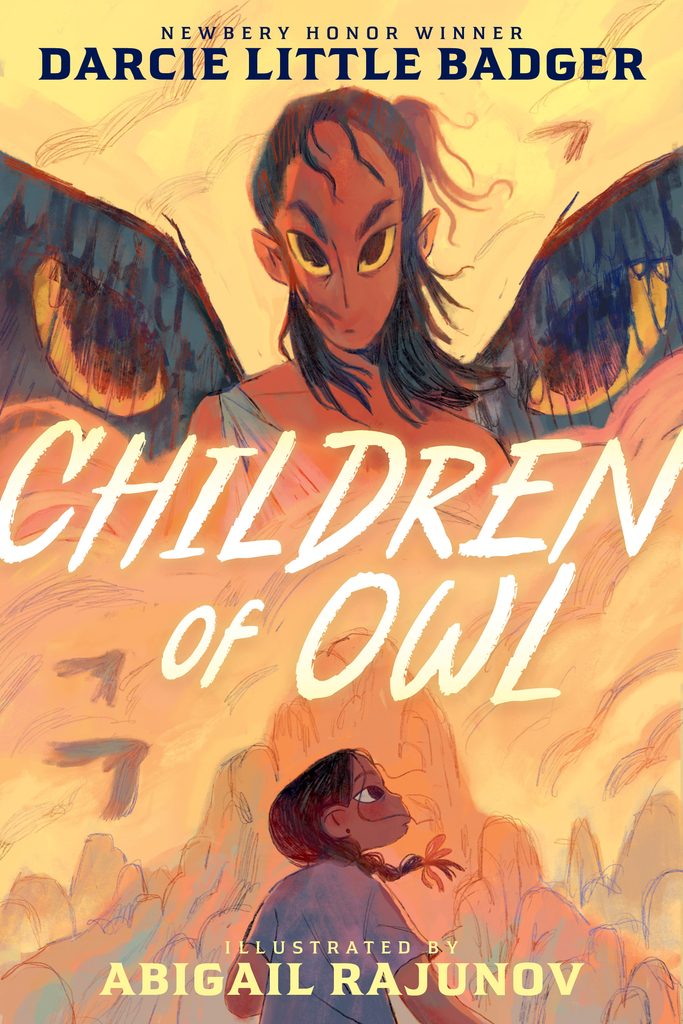
Through prose and twenty-five comic pages (with art by Abigail Rajunov), Children of Owl tells the story of Maisie, a teenager living in South Texas. When Maisie sees the son of Big Owl, she worries that he’s a harbinger of doom for one of her cousins. As she says, “Owls can be a sign of tragedy; they’ll come before the buzzards circle.” So she becomes involved in her cousins’ extremely strange lives, encountering forces such as ghosts and shapeshifters, in an attempt to defy fate and save her family. The story is told through multiple perspectives and formats. In that respect, it’s an ambitious project, and I’ve been working on it for seven years.
Children of Owl is the most personal book I’ve written; it’s also firmly grounded in reality. Although—like everything I write—the fantastic makes an appearance.
As the author of several books, how would you say your writing process has changed and/or stayed the same since the beginning of your career?
Over time, I’ve learned to trust my instincts about what does and doesn’t work. And I’ve definitely become more experimental with my creative projects. For example, Children of Owl uses first-person diary entries, comic pages, and third-person prose to tell a story. But generally, my writing process has remained consistent. My first drafts are chaotic. I’ll write book fragments in journals or directly on a laptop and then combine the project in one document. My workspace spans coffee shops and the home office; at home, my pug supervises my work. After the first draft is completed, I always print the project and make edits by hand with colorful pens.
What’s something you wish you had known as a writer earlier on?
I wish I’d used a pseudonym, honestly. That would’ve been fun. I would’ve chosen an elegant, gothic name.
What’s a question you haven’t been asked yet but that you wish you were asked (as well as the answer to that question)?
Question: “Would you like to play a horror TTRPG with me on my Twitch stream?”
Answer: “Yes, that sounds like fun!”
What advice might you have to give for any aspiring writers?
First drafts don’t have to be polished. That’s the point of editing! In fact, most books are revised multiple times.
Also, rejection is a big part of publishing. As a young writer, I was rejected over one hundred times before my first “pro” short story got accepted by Strange Horizons. Be persistent. Continue writing stories that interest you; continue improving your craft; continue reading and growing. Don’t let rejections make you feel like less of an artist. Instead, be proud of your bravery.
Are there any other projects you are working on and at liberty to speak about?
This has been under wraps, since it’s not officially announced yet, but I’ve been working on a ten-issue comic project for Ignition Press. It’s dark fantasy/horror themed, and I can’t wait to share more. I’m also writing a couple books; wish me luck, as they’re at that troublesome “early first draft” stage.
Finally, what books/authors would you recommend to the readers of Geeks OUT?
I’m a judge for the Ursula K. Le Guin Prize for Fiction, and all the nominees this year are great. Seriously, check them out. For people into horror, Back for Blood: Never Whistle at Night II just dropped, and its TOC is on fiiiiire.
0 Comments