
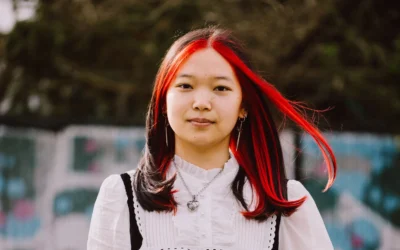
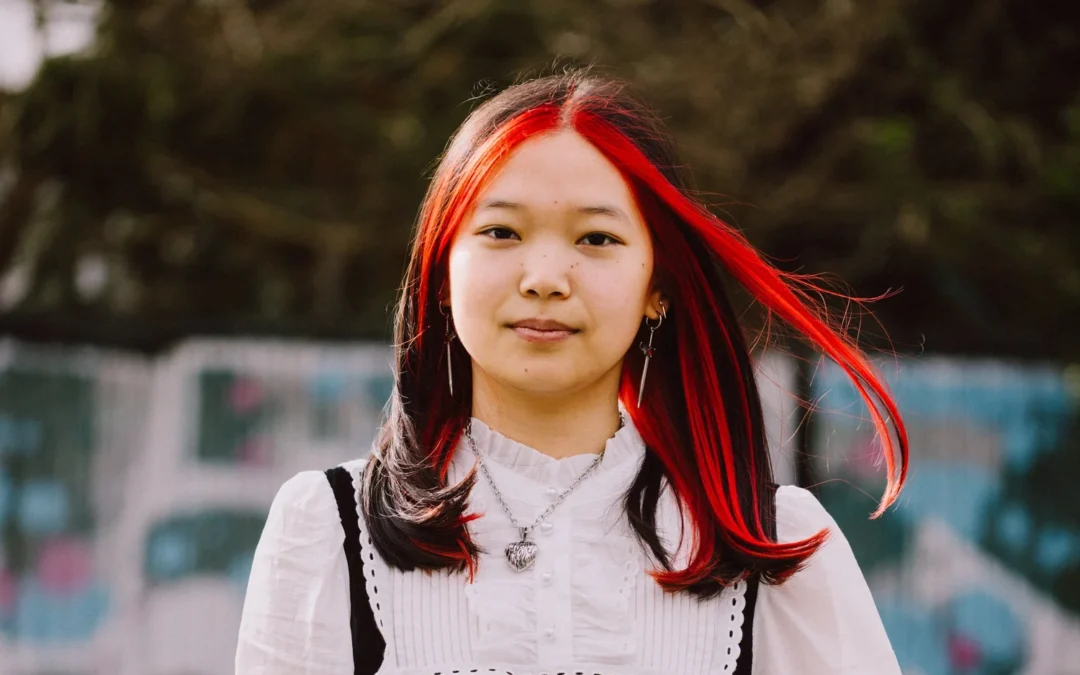
Abigail Savitch-Lew is a writer of fiction and nonfiction and an American of Jewish and Chinese (Ashkenazi and Toisanese) descent. She has a BA in literary arts from Brown University and an MFA in fiction from Rutgers University-Newark. She is the author of the novel Livonia Chow Mein, and her short stories have been published in The Round, Post Road, The Best Teen Writing of 2010, and The Apprentice Writer. Previously, she was a staff reporter for City Limits, an Asian American Writers’ Workshop Margins Fellow, and an adjunct professor of creative writing at Rutgers. She lives in Brooklyn with her husband, the artist Emmanuel Knight, her sister-in-law, and their cat.
I had the opportunity to interview Abigail, which you can read below.
First of all, welcome to Geeks OUT! Could you tell us a little about yourself?
Thank you, yes! I was born in 1992 and raised in the rapidly gentrifying borough of Brooklyn, New York. I come from a multiracial, multiclass family. I love to read and decided to become a writer when I was eight years old. In my twenties, I worked as an NYC housing reporter for a nonprofit news organization.
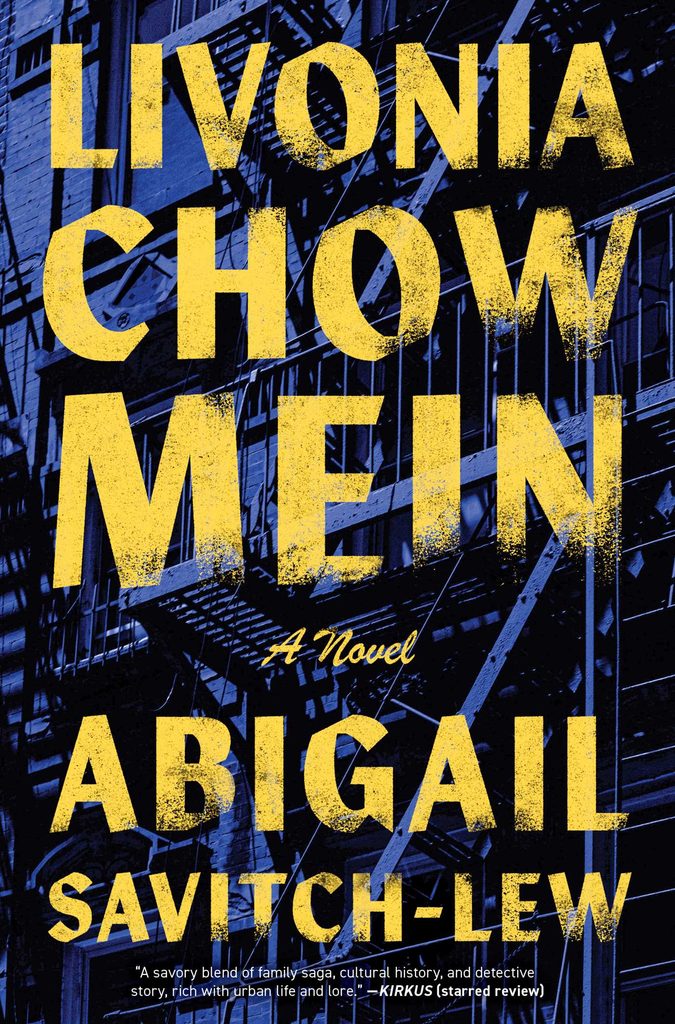
What can you tell us about your book, Livonia Chow Mein? What was the inspiration for this story?
From start to publication, this book took me twelve years! In the beginning, I was inspired by my grandmother’s stories of surviving the Japanese occupation of China, immigrating to the United States, and helping my grandfather run a Chinese restaurant in Brownsville, Brooklyn. Yet the more I learned about Brownsville—through research and interviews, as well as through my day job as a housing reporter—the more I was moved by the neighborhood’s remarkable history as a center of the struggle for Black self-determination and community control. Ultimately, this book wrestles with how multiple communities can become complicit in white supremacy, and it seeks to imagine a pathway toward authentic solidarity.
As a writer, what drew you to the art of storytelling, especially fiction?
To answer this question, I’ll tell you a story. When I was six years old, I would dictate stories to my father, and he would type them in real time onto our home computer (a gigantic beige Macintosh that took up an entire desk table). Often, the games of “pretend” I played with my friends in the yard of our public school became the seeds for these strange stories, which were usually about talking pigs or friendly neighborhood vampires. Eventually, we wrote a story called “Two Humongous Rocks,” about two skyscraper-tall, invisible rocks on a sidewalk in Brooklyn. (This was three years before September 11 changed our city, so I wonder if the Twin Towers provided some subconscious inspiration!) Dad printed the story, which I delivered as a gift to my first-grade teacher, the wonderful Ms. Kathy Collins. She later decided to read it to the class, and she shared with my peers that it was authored by an anonymous first grader. The class was mesmerized by “Two Humongous Rocks.” I couldn’t believe I had succeeded in transporting my peers into the world of my imagination. It was such a validating experience for me that I decided then and there that I would keep writing stories for the rest of my life. And here we are.
How would you describe your creative process?
Much less free-flowing these days than it used to be. I’ve become an outliner, a planner, sometimes to a fault. As I go about my day, I write ideas—sometimes they are simply sensory observations—into the Notes app of my iPhone, and later I try to synthesize these into narrative. No matter how much I outline, it’s a messy and haphazard process, lots of stop-and-go.
What are some of your favorite elements of writing? What do you consider some of the most frustrating and/or challenging?
Coming up with an original simile is such a satisfying experience! So is having a mini-epiphany and realizing what needs to be done—in terms of plot, for instance, or structure—for everything to come together.
So much is challenging! Deciding whether to keep writing forward or go back and revise…determining whether one is under-planning or overplanning…incorporating research and politics without the narrative become didactic or bogged down…so many things.
As an author, who or what would you say are some of your greatest creative influences and/or sources of inspiration in general?
Toni Morrison, James Baldwin, Colson Whitehead, James McBride, William Faulkner, Leo Tolstoy, Gabriel García Márquez…basically, I gravitate toward writers who capture a sense of place and time using a wide expanse of characters, writers who are interested in how individual navigate and are shaped by the political systems and economic structures into which they are born.
Usually, I judge a book by how much it makes me cry. The more tears, the better the book.
Have there been any Asian American or Jewish creatives/books which inspired you?
The contemporary writers Lisa Ko, Nina Sharma, and Aisha Abdel Gawad write the most gorgeous prose. There’s great forward momentum and emotionality to their work, and they also are grappling with some of the most pressing social issues of our time. (And they’re all mentors to me and the kindest, most generous people.)
I’ve spent a lot of time reading Asian American Literature and I’m only just now beginning to dive more into Jewish literature. For now, I’ll say that I was deeply moved by Peter Beinart’s Being Jewish After the Destruction of Gaza: A Reckoning.
What’s a question you haven’t been asked yet but that you wish you were asked (as well as the answer to that question)?
No one has asked me yet about my sexual orientation and how it’s reflected in my work. Perhaps this is because I present as somewhat cis-gendered right now, and I’m happily married to a heterosexual, cis-gendered man.
I’m bisexual or pansexual, and it’s important to me that my characters reflect our world’s diversity of sexual orientations and gender expressions. In Livonia Chow Mein, queer love is not the main plotline, but it is an important side-story for a couple of the characters.
What advice might you have to give for any aspiring writers out there?
Publication does not make you a writer. Nor does talent. To be a writer, you must make a real habit of it, a practice—and practice your practice no matter what insecurities creep up. Keep going! Also, find peers and mentors who understand the intention of your work and can help you make it better. Save your old drafts, make new drafts, and revise (and revise and revise and revise and revise).
Are there any other projects you are working on and at liberty to speak about?
I’ve been co-writing the memoir of a very special person in my life; we’re excited to put this out in the world, and hopefully there will be more news soon.
I’m also beginning to draft a novel about a romantic relationship between a Black violinist and a Jewish tenant organizer during the fascist takeover of the United States (a.k.a., now).
My Jewish grandmother had a fascinating life story, and I’ve begun a non-fiction project to document her life and explore my family’s complicated relationship to trauma, to whiteness, and to Zionism.
Finally, what books/authors would you recommend to the readers of Geeks OUT?
I’d like to recommend some books I absolutely love that grapple with queer identity—again, not always as the main storyline, but as the inner truth of a complex character.
P.C. Verrone’s Rabbit, Fox, Tar
James Baldwin’s Just Above My Head
Sarah Aziza’s The Hollow Half
River Dandelion’s remembering (y)our light
John Keene’s Annotations
Alice Walker’s The Color Purple
Michelle Hart’s We Do What We Do In the Dark

0 Comments