
Shaun Tan is an artist, writer, and filmmaker from Perth, Western Australia. He is the recipient of an Academy Award, the Astrid Lindgren Memorial Award in Sweden, and the Kate Greenaway Medal in the United Kingdom. He lives in Melbourne with his wife, two children, and various species of plants and animals.
I had the opportunity to interview Shuan, which you can read below.
First of all, welcome to Geeks OUT! Could you tell us a little about yourself?
I’m a West Australian writer and illustrator living in Melbourne, with a background working with science fiction, children’s literature and other genre fiction such as fantasy and horror – I have good geek stats. I grew up in suburban Perth, always being pretty good at drawing and interested in weird stories. When I was about eleven my parents introduced me to old reruns of The Twilight Zone (one of their own favourite shows, originally airing in the late ‘50s) and this triggered my interest in unusual short fiction and this central idea of ‘nothing is as it seems’. My life, education and career has since followed a convoluted path, as most people’s do, but it’s interesting to reflect that I’m back writing and drawing somewhat Twilight-Zonish stories, the same kind of thing that interested me most as an eleven-year-old.
As an artist, what drew you to illustration and creating works for young readers?
Circumstance really. The first real book commission I was able to acquire as a freelance illustrator came from a children’s publisher, particularly some horror stories for upper elementary school students – possessed cats, creepy towns, murderous dolls, dead kids haunting sewers, things like that. This was actually great training for visual narrative of any kind, because horror involves building interest and suspense without showing the central object of fear; you need to find clever tangents and indirect forms of visual expression. Because it’s for younger readers, it can’t be academically clever; it must be emotionally clever, universal, accessible – but still sophisticated. This is true of all children’s literature, which I believe is the most surrealist of all literary genres, and its audience is pretty critical. Good illustration, like good writing, is about showing without showing, telling without telling. This is perhaps one reason I’ve continued working in this field, not so much a specific interest in young readers, but an interest in the way young readers view the world without the kind of presumption or prejudice that can besiege us oldies. Children are naturally closer to being artists than most adults; they have the same sense of possibility and facility for vastly suspended disbelief, less rationalising inhibition when faced with an outlandish ‘what if’ question.
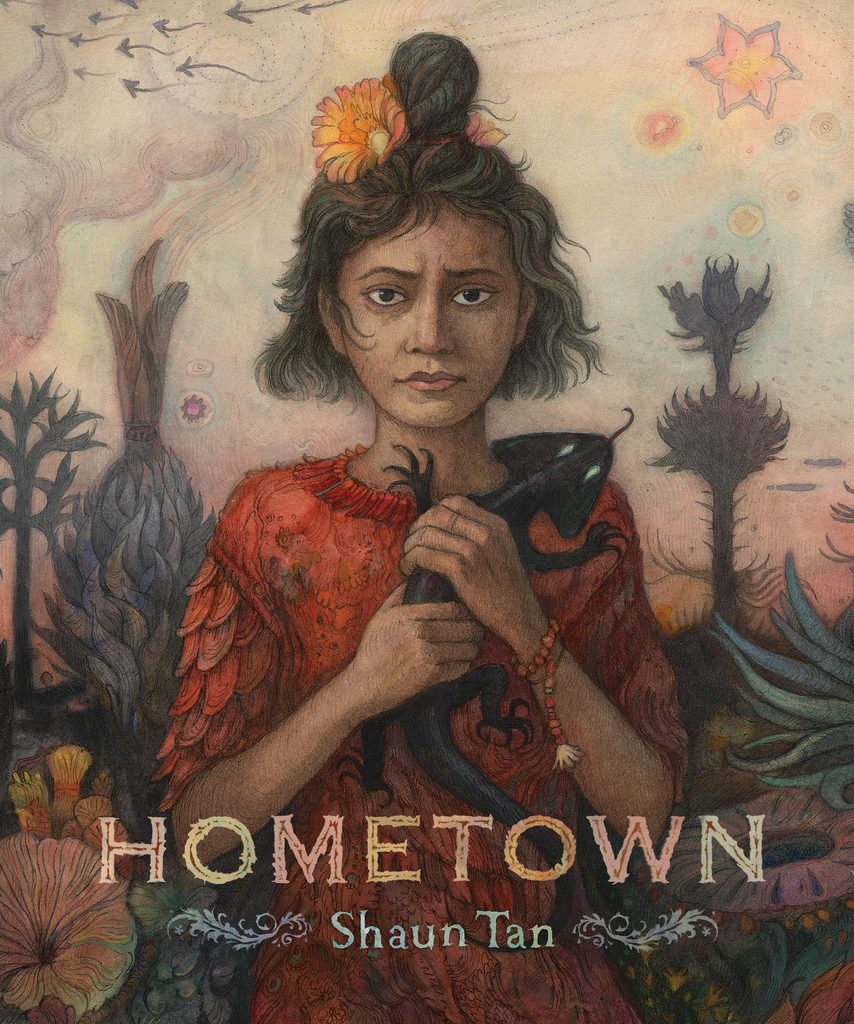
What can you tell us about your latest book, Hometown?
It sits somewhere between a graphic novel and a picture book, and tells the story of a teenage girl who has grown up in a very strange, otherworldly family and neighbourhood. One day a visitor arrives to tell her that she does not belong in this place that she loves, that she in fact has never belonged here, and must return with him immediately. This, of course, throws her whole sense of self into a spin, and she must make a decision whether to believe this stranger or not. This is further complicated by the fact that her own family suggests that the stranger is telling the truth. It’s a big dilemma, and the driving force behind the creation of the complex illustrated world of Hometown.
What are some of your favorite elements of illustrating/writing? What do you consider some of the most frustrating and/or challenging?
I think my favourite elements are the funniest. At heart, I think I am something of a cartoonist. In fact, the first job I ever really applied for was one for a newspaper gag cartoonist, drawing weird pictures with funny captions: a glass-bottom bus tour, a levitating student told to get back to his seat, a prehistoric funeral service offering sedimentary fossilization. Hometown is perhaps not far removed from this genre, a kind of oblique, funny thinking that casts light on the arbitrary – and very weird – nature of the ordinary. For instance, there is a moment in the book where the narrator explains that her family took a guest out for dinner. The drawing shows a violent and terrifying hunting scene, followed by the whole family gleefully tearing the innards out of a giant insect, and wondering why the visitor is no longer hungry.
This kind of black humour is a great driver for deeper philosophical insight, I think, both for myself and the reader. What the family is doing is actually far less disturbing than the process of industrialized slaughter that happens every day in our own world, and even more respectful, and historically normal, in many ways. Moreover, it draws attention to cultural differences, that there is, in fact, no such thing as ‘normal’. This kind of picture-story is great for approaching these ideas.
The most frustrating part of writing and illustrating? Gosh, where do I begin! I think it’s just the age-old problem that every illustrator, writer, musician, athlete, mathematician etc. has, of getting things technically correct enough that the right spirit flows seamlessly, without apparent effort or doubt. In the case of writing, it’s getting the words to lock together like a smooth channel for thoughts to flow, but not in any singular direction, open to a little ambiguity. There’s a ton of revision with even the simplest phrase. With drawing, it’s things like getting faces and hands right, just enough so that they don’t interrupt the illusion of another internally consistent reality, as seamless as our own. I’m not actually a great draughtsperson, especially with figures, but I can work within my limitations and make the style suit. I am also happy if things are not perfect, because it’s more like real experience that way. Like most artists, though, I do wish I could draw and paint a little better!
As an author, who or what would you say are some of your greatest creative influences and/or sources of inspiration in general?
That’s a great way of framing the question of influence. People always ask who, when a what is more appropriate in the first instance. You are inspired by things first, then you go and look at how other people might have tackled a parallel interest. The short answer is nature. More particularly, landscape for me. If not writing and illustrating these strange little stories, I would choose to be out painting landscapes, usually in my local suburb of inner Melbourne, just with a small box of oil paints, working on tiny wooden panels (I often post these on Instagram). I would say the majority of influences on a book such as Hometown come from walks around my local neighbourhood, observing trees, houses, sidewalks, possums and cats, powerlines, clouds, light and shadow. Accordingly, some of my biggest human influences have been painters and writers who focus as much on landscape, particularly natural landscapes, as much as people: Claude Monet, Arthur Streeton, Edward Hopper, Richard Diebenkorn, Cormac McCarthy, Tim Winton, a couple thousand more.
Aside from your work, what are some things you would want readers to know about you?
Not much really, ha ha. I’m a pretty private person, and I don’t think anything in my day-to- day life or background is particularly unusual or noteworthy, nor does it have much bearing on the imaginative work that I do at the drawing table. I’m a parent of two school-age children, which is, I think, my biggest achievement, certainly the most demanding job I’ve ever taken on (other artist/parents nodding knowingly as they knock back their double-shot whatever).
One thing I’ll say in answer to your question is that I’m always surprised when interviewers have mentioned that I look ‘more like an accountant than Salvador Dali’, ‘A boy scout’ or, in one memorable case, ‘unsophisticated ’, which is an odd thing to say, really, because the most wildly imaginative creators I know are not especially extroverted (they don’t need to be) and I’ve also met some pretty wild accountants; they are far from ordinary people! I think some readers might like to know that our family has a Boston Terrier, only because Boston Terrier owners are always interested to hear this; it’s a strange little club. We also live with a 27-year-old parrot named Diego, who has been quite an influence on some of the creatures in my stories.
What’s a question you haven’t been asked yet but that you wish you were asked (as well as the answer to that question)?
Wow, another excellent question. I think a good one to ask any creative person is ‘what don’t you like about your own work?’ Because we think about this all the time, perhaps all professionals do, if they are serious about quality control and improvement. For me, I think my work is a little too overwrought. I think about things too much instead of trusting my instincts. I have great respect for those artists who approach work like a golf swing: lots of practice, and then a single confident swoop, and it either lands or it doesn’t. I respect live performers for the same reason. They are not afraid of failure or embarrassment, at least not enough to avoid the stage. Good art is a child drawing in the sand as the tide comes in, the ideal state we all aspire to – caring and not caring at the same time. As a book illustrator, I’m a bit more of a fussy builder: multiple sketches, one traced over another, incremental adjustments and careful executions. That’s just the way I work, the way I think, my personality, far from wild and free. But this fussiness is also kind of necessary to tell a continuous story across a complicated visual narrative. I’m getting better at navigating this paradox, though. I think with Hometown there is much more impulsive, hard-to-explain drawing and intuitive gesture in the linework, so I think I’m improving. A long way to go, though; I feel like I’ve only just graduated from a high school art class.
What advice might you have to give for aspiring creatives out there?
Get good at drawing. Be your own best critic (then you don’t have to worry about other withering feedback so much). And maybe easiest to remember: finish! I think that’s the best advice, which was given to me by others: just really try and finish what you start, even if it’s not terribly good. That’s an important discipline, and also helps against the misery that can accrue from lots of unfinished projects, wearing down on your confidence. The final bit of advice I would give to an aspiring creative: expect to get very depressed about your own work. This is normal! There will be times when you are certain everything you do is a pile of crap. Maybe you’re right, maybe you’re not. The only way to find out is to keep going, finish, move on to the next thing. Just do the work. Forget inspiration or talent; stubborn persistence is the thing that makes a good artist: just doing the work, ploughing through it even when all joy and inspiration evaporate, when it is neither fun, artful, critically or financially rewarding. The successful artists just keep on ploughing.
Are there any other projects you are working on and at liberty to speak about?
Not particularly. Meaning that there are none, rather than not being at liberty to speak of them. I’m still working on this one – Hometown – to be honest, fielding interviews such as this! Which is a large part of the book-making process, connecting to readers, opening the work to a larger discussion beyond the secrecy of the studio. Readers interested in my work might like to check out a TV adaptation of my book Tales from Outer Suburbia, which I had a small part in creating, a 10-episode children’s series with magic-realist tones, set in ‘80s suburban Australia, freely available in the US.
Finally, what books/authors would you recommend in general to the readers of Geeks OUT?
At the moment I’m reading ‘Trickster Makes This World’ by Lewis Hyde, which is a fascinating study of the traditional role of tricksters in stories around the world, and what bearing this has on contemporary life. I’m always interested in folktales as the real ‘mainstream’ of human literature, and how the impulse to tell dream-like fables finds a modern equivalent, often what we now call fantasy, magic realism or science fiction. These are not marginal genres, I’d argue; historically, they are the centre, the same might be said for children’s and ‘YA fiction’.
Over the years, books that have left a big impression on me include ‘The Illustrated Man’ by Ray Bradbury (which got me interested in writing as a teenager), the comics of Daniel Clowes and Chris Ware, short fiction by Italo Calvino and short stories by Australian Peter Carey. Other books that come to mind are ‘How We Are Hungry’ by Dave Eggers, ‘The Road’ by Cormac McCarthy, various comics by Jillian Tamaki, ‘Magic for Beginners’ by Kelly Link, ‘The Wind Up Bird Chronicle’ by Haruki Murakami, ‘Ethel and Ernest’ by Raymond Briggs, and I recently enjoyed ‘Subdivision’ by J. Robert Lennon. I also recommend picture book creators Chris Van Allsburg (especially ‘The Mysteries of Harris Burdick’), Edward Gorey, Sydney Smith and Kitty Crowther. I’m sure I’m forgetting a ton of others! Including cartoonists such as Gary Larson, Paul Noth, Edward Steed, sitting very much in the vein of surrealist short fiction that also taps into cultural truth through a hidden side door.
0 Comments