
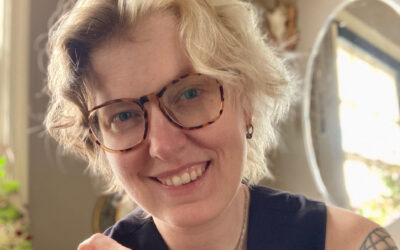
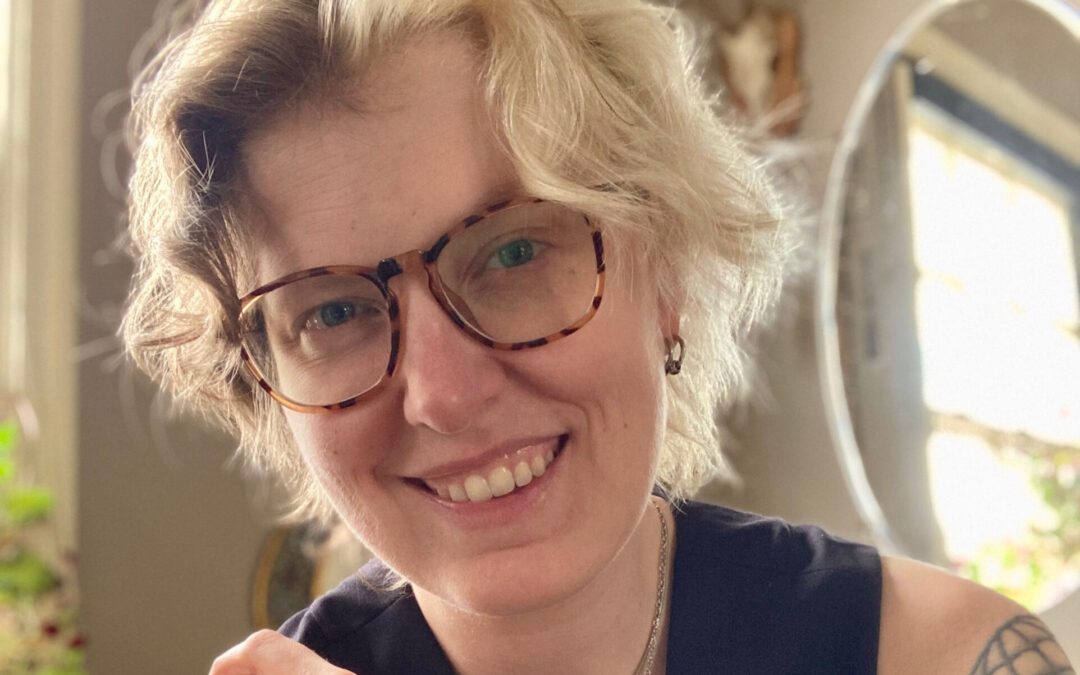
CALE PLETT is a nonbinary, genderfluid writer who lives on Treaty One Territory in Winnipeg, Manitoba. Their YA novels span everything from high school rock bands to nightmares in the woods to reality TV gone wrong, and their poetry and short fiction can be found in a whole variety of journals. Whatever genre they’re writing, they try to create spaces where queer characters can exist safely within their identities. Wavelength, a runaway pop star YA romance, is their debut novel from Groundwood Books. Their second YA novel, The Saw Mouth, is coming out May 12, 2026 from Delacorte Press, to be followed by another standalone YA horror novel, Stranglehold, in fall 2027.
I had an opportunity to interview Cale, which you can read below.
First of all, welcome to Geeks OUT! Could you tell us a little about yourself?
Thanks for having me! Queer geeks are my favorite people on earth. Like yes, I identify as nonbinary and genderfluid, but first of all I identify as a queer nerd. My name’s Cale Plett (they/them), and I’m the author of two YA novels: Wavelength, a runaway popstar romance, and now my first horror novel, The Saw Mouth, out May 12, 2026! I love monsters and abandoned buildings and when characters kiss in the rain.
What can you tell us about your new book, The Saw Mouth? What was the inspiration for it?
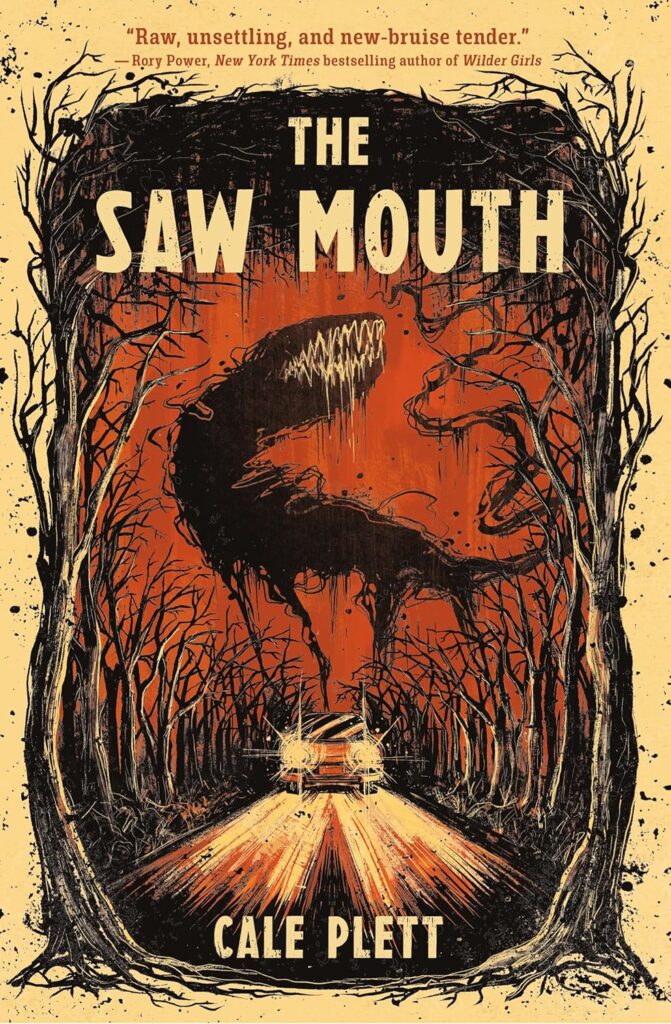
The Saw Mouth follows Cedar ten years after a nearly-dystopian day called Autumn, when the tortured, fragmented souls inside machines woke up and destroyed themselves, setting technology back decades. Cedar moves to a small lake town called Sawblade Lake because they’ve got nowhere else to go, but something else follows them. A menacing shadow, a long, stalking, stinking being of darkness, a gaping maw. Soon this monster sinks its teeth into their life and starts targeting what Cedar loves, trying to break them. As Cedar tries to stop it, they begin to realize that what’s haunting them might link back to Autumn, the house they grew up in, and the darkest moments of their life.
The clearest inspiration point is a highway intersection. Which sounds boring. It is, during the day, but at night, you’ve been driving for a couple hours on two lanes surrounded by lakes and forest, and then there’s a flickering streetlight at this intersection. Like a haven holding the vast darkness back. It’s fragile and desperate. It’s something to cling to. You hope it holds out. You hope you hold out. That led to the place where The Saw Mouth starts.
As a writer, what drew you to the art of storytelling, especially young adult fiction and speculative fiction?
I think stories are one of the only ways the world makes sense to me. Maybe other people have philosophy or physics, and I’ve got stories. It’s been that way since I was a kid. Stories were when things inside me clicked into place.
I thought I wrote YA when I was a teenager because I was the age of the characters. I was entirely wrong. I keep loving it more and more. Obviously, I love writing about young people. Personally, I don’t think I’ll ever finish unpacking that part of my life, along with the newer, younger queer parts of myself that feel like teenagers again and again. But YA often also has distinct genre aspects. Some pacing tendencies I love, a focus on character above all else, a slant toward hope.
Speculative fiction… it was the monsters. It was chasing after fears that are worse than death and finding what crawls under my skin and curls up in my brain to keep me awake at night. Horror felt like a specific version of how stories have always felt. When I write horror, I’m making sense out of the world.
How would you describe your creative process?
Oh god. There’s a lot of movement between organization and chaos. For instance, my writing is fairly scheduled and predictable. I never write at night. I never have massive wordcount days. However, that writing happens in something I call the Hell Doc. Some people use Scrivener and make everything beautiful, and I just have this giant, messy thing that’s got the draft and then literally twenty thousand words of notes, outlines, character lists, timelines, excerpts from old drafts, et cetera in their own non-system of italics, bold, and multicolored highlighting. There are no page breaks in the Hell Doc. I’m a big believer that if there’s a writing method that works for you, you shouldn’t try to do someone else’s more aesthetic method. (No shade to those with more aesthetic methods. I admire you.)
My stories tend to start with concepts, and then I have to let the characters talk to each other and walk around before I get them sorted out. I often know the first and last beats of the novel, and then chart the course between them. If I’m stuck, I free write my way out of it. It’s a lot of “what about this? Or this? Definitely not that. Ooh, this might work!”
And help from others. There are a few trusted people in my life who see my work before it goes out. Then my agent, Amy Tompkins, and eventually, my amazing editors (Emma Sakamoto for Wavelength and Ali Romig for The Saw Mouth and Stranglehold) work their magic.
What are some of your favorite elements of writing? What do you consider some of the most frustrating and/or difficult?
My favorite element is dialogue. Maybe that’s because I love to talk a lot. Outside of that, I’m happiest when I hit the exact right short little phrase said in simple language. When you land on the five or six words to break someone’s heart.
The hardest part is not getting frozen. I’m a very precise first draft writer (despite my methods), and it’s usually for worse. The phrasing rhythm doesn’t have to be perfect yet. It doesn’t have to be good. It just has to get from the start to the end.
As an author, who or what would you say are some of your greatest creative influences and/or sources of inspiration in general?
The songwriter Josh Ritter has been a huge influence on how I navigate imagery and concept in my writing, on the weaving and layering of ideas with story. Rory Power and the way her writing cuts and swerves (and in nerdy things, she coached me through beating Baldur’s Gate 3 on Honour Mode for the first time). Becky Chambers and EK Johnston for their ability to balance ferocity with tenderness. Andrew Joseph White and Alice Oseman for each healing different parts of me.
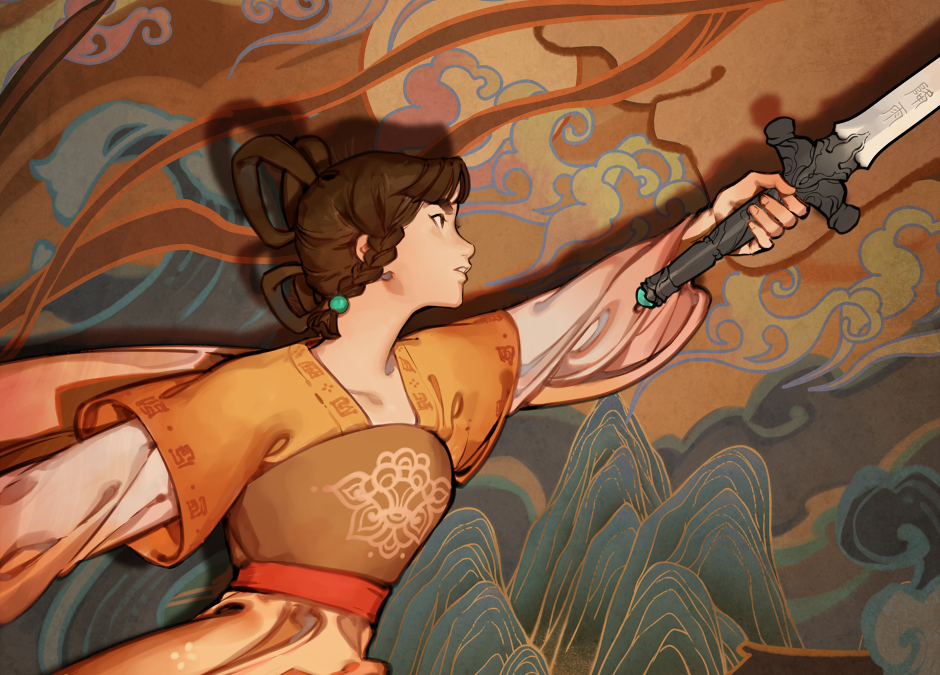
And the artists who’ve worked on my own books. Bhavna Madan and Evangeline Gallagher, who did the cover art for Wavelength and The Saw Mouth respectively, and Dani Martineck, who narrates The Saw Mouth audiobook. They all launched off and made things so entirely beyond what I could create. It makes me want to make even better work to place into another artist’s hands.
Aside from your work, what are some things you would want readers to know about you?
Yeah, I’ve got a soapbox. I think that if authors won’t stand up for all the human rights of young people – as they’re relatively safe to do so – they shouldn’t work in the children’s book industry. You don’t get to pick and choose. You have to stand for food stamps and healthcare and trans rights and Palestine and gun legislation and Indigenous rights and against deportation and genocide and predators in office. You have to be willing to lose readers and to make enemies. We owe that to young people.
What’s a question you haven’t been asked yet but that you wish you were asked (as well as the answer to that question)?
Q: What albums did you obsess over while writing The Saw Mouth?
A: Fletcher’s Girl of My Dreams and Bryan Adams’ Reckless.
What advice might you have to give for aspiring storytellers out there?
Don’t use generative AI for any part of your creative process. Not research, not drafting, not editing, not problem solving. Just write your own damn work and fuck up and get better. You will wind up with someone else’s stolen, cobbled together story instead of something you can be proud of. Plus along with gobbling everyone’s art and water, generative AI is racist in like a dozen different ways.
That, and learn to be edited. Writing is collaborative. It’s not you versus the world.
Are there any other projects you are working on and at liberty to speak about?
Yes! I have another queer YA horror novel coming out with Delacorte in fall 2027! It’s called Stranglehold. In actual pitch terms, think the smalltown, twisted miracle of Mike Flanagan’s Midnight Mass crossed with the frozen, cosmic dread of True Detective: Night Country. A long, rattling panic attack driven by an ancient god from the old world, revenants serving as its lungs, and a coming harvest that could slaughter the entire population with the hands of their own loved ones.
I’m very excited about it. Stranglehold’s setting is in my bones, all desolate and winter-barren. Almost the entire book happens over the course of three days during a massive snowstorm. I’d like to think it pairs well with The Saw Mouth.
Finally, what books/authors would you recommend to the readers of GeeksOUT?
This list goes YA horror, one random sci-fi, then YA romance!
The Black Girl Survives in This One: Horror Stories edited by Desiree S. Evans and Saraciea Fennell
The Gathering Dark: An Anthology of Folk Horror edited by Tori Bovalino
Burn Our Bodies Down by Rory Power
To Be Taught, If Fortunate by Becky Chambers
Lake Life by Tanya Boteju
Buried Feelings by Kit Rosewater (there’s puzzles to solve!)
That Inevitable Victorian Thing by EK Johnston
0 Comments